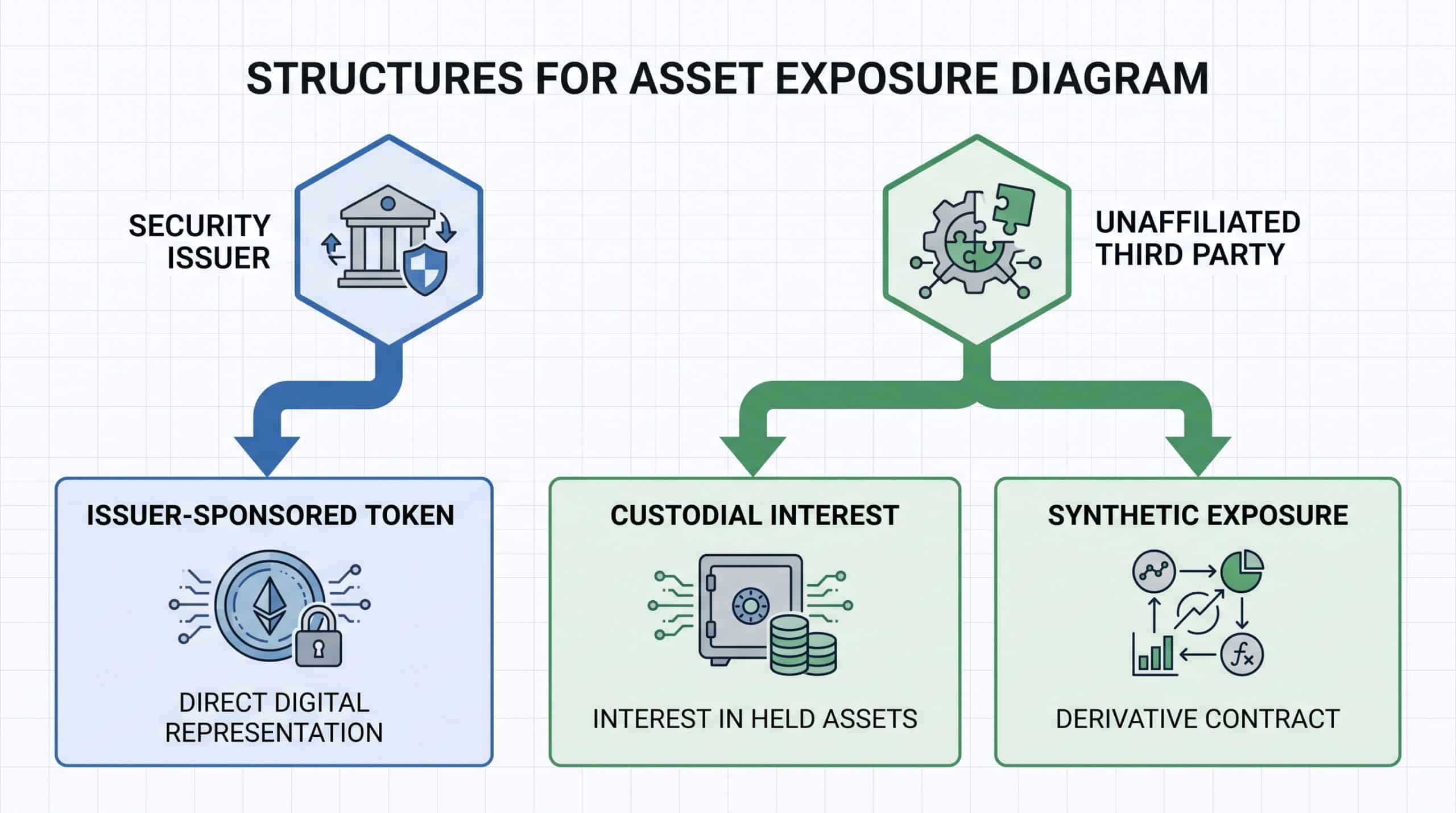


The U.S. Securities and Exchange Commission’s Division of Corporation Finance published its Statement on Tokenized Securities on January 30, 2026. The statement describes tokenized securities as securities represented by a crypto asset and explains that tokenization can be performed by an issuer, a party acting on the issuer’s behalf, or an unaffiliated third party. The central point is straightforward: using blockchain infrastructure does not, by itself, change the application of federal securities laws. Read the SEC’s Statement on Tokenized Securities.
What the SEC statement clarifies
The SEC statement organizes tokenized securities into two broad categories. The first covers securities tokenized by an issuer or on the issuer’s behalf. The second covers securities tokenized by a third party that is not affiliated with the issuer. That distinction gives investors, issuers, and platform operators a useful starting point for examining who created a token and what relationship, if any, exists between the token and the underlying security.
For readers, the category matters because the label “tokenized security” does not answer every practical question. Before relying on a token’s description, identify the issuer, the tokenization provider, and the records or agreements that define the holder’s rights. A blockchain entry may be part of the arrangement, but you still need to understand what that entry represents.
Issuer-sponsored tokenization
In the first category, an issuer or a party acting on its behalf creates the tokenized representation. The SEC statement distinguishes between arrangements in which the crypto asset is itself the security and arrangements in which the crypto asset serves as a record of ownership for a security held through another system. These structures can look similar on a trading screen while relying on different legal and operational records.
Ask which record controls ownership if information conflicts. Review the issuer’s disclosures and the documents governing transfers, distributions, voting rights, and recordkeeping. Do not assume that possession of a blockchain token necessarily provides every right commonly associated with direct ownership. The governing documents, rather than the technological label, explain the arrangement.
Third-party tokenization
The second category involves an unaffiliated third party. According to the SEC statement, a third party may hold an underlying security and issue another instrument representing an interest in it, or it may create a synthetic instrument that provides economic exposure without conferring ownership of the referenced security.
This distinction deserves careful attention. A token linked to a security’s value is not necessarily the same thing as the security itself. When assessing a third-party product, determine whether an underlying security is actually held, who holds it, what claim the token holder has, and what happens if the third party cannot perform its obligations. If the product is synthetic, examine the contractual terms rather than assuming the token conveys shareholder rights.
What tokenization does not change
The SEC’s stated position is that federal securities laws apply based on the instrument and transaction, not merely on whether blockchain technology is used. Tokenization may change how ownership or exposure is recorded, transferred, or displayed, but it does not automatically remove a security from the established legal framework.
That means a project description should be tested against its actual structure. Marketing language such as “on-chain,” “wrapped,” or “synthetic” cannot substitute for an explanation of the holder’s legal rights. A useful review starts with the parties, the underlying asset, the governing agreement, and the records used to establish ownership or exposure.
A practical review checklist
- Identify the issuer: Determine whether the security issuer participates in or authorizes the tokenization.
- Identify the token provider: Establish whether it acts for the issuer or independently.
- Define the holder’s rights: Check whether the token represents the security, a beneficial interest, or contractual economic exposure.
- Locate the controlling records: Find out whether ownership is determined on-chain, in an issuer-maintained register, in a custodian’s records, or through a contract.
- Review counterparty dependence: For third-party structures, understand which obligations depend on a custodian, broker, platform, or other intermediary.
- Read the disclosures: Compare promotional descriptions with the formal terms governing transfers and holder rights.
This checklist does not determine whether a particular product complies with securities law. It helps expose the questions that must be answered before treating different tokenized products as equivalent.
Temporary relief for certain trading systems
In September 2026, the SEC announced a temporary, conditional innovation exemption intended to facilitate trading in tokenized NMS stock through qualifying tokenized securities venues operating in a permissioned environment. The relief is specific and conditional; it should not be read as a general exemption for every tokenized security or platform. See the SEC announcement and its conditions.
The announcement reinforces the need to examine the precise scope of any regulatory relief. A platform should not be assumed eligible merely because it uses blockchain technology or offers tokenized instruments. Readers should verify the covered instruments, venue requirements, conditions, and duration in the SEC’s published materials.
Questions readers should ask
Does blockchain status determine whether an instrument is a security?
No. The SEC statement explains that federal securities laws continue to apply to tokenized securities. The technology used to represent an instrument does not independently determine its legal treatment.
Are all tokenized securities structured alike?
No. The SEC identifies issuer-sponsored and third-party models, with further differences in how ownership or economic exposure is represented. The product’s documents must establish which model applies.
Does every token linked to a stock provide stock ownership?
No. The SEC statement describes third-party structures that may provide synthetic economic exposure rather than ownership of the referenced security. Confirm the holder’s rights from the governing terms.
Is the innovation exemption available to every tokenized trading platform?
No such general availability is stated in the supplied evidence. The SEC describes temporary, conditional relief for qualifying venues and tokenized NMS stock in a permissioned environment. Eligibility depends on the published conditions.
The essential takeaway
Tokenization is a method of representing or tracking a financial arrangement, not a complete description of that arrangement. Start by identifying who issued the token, whether the issuer authorized it, what asset or contract supports it, which records establish the holder’s position, and which parties must perform. Those questions help distinguish direct security interests from custodial or synthetic exposure without relying on a product’s technological branding alone.