

SEC Clarifies Rules for Tokenized Securities on Blockchains

SEC Clarifies Rules for Tokenized Securities on Blockchains

Here’s something that caught everyone off guard: by January 29, 2024, the market had already dropped 30% from its October highs. Bitcoin sat at $82,138 and Ethereum at $2,737. That’s exactly when the SEC decided to drop comprehensive guidance on tokenized securities.

I’ve been watching this space since 2019. Back then, asking three lawyers about token classification got you four different answers. People were building projects without knowing if they’d face enforcement later.

But here’s what changed. The SEC released a blockchain regulatory framework that finally connects the dots. It shows how existing laws apply to digital assets and tokens.

The timing was interesting. Chair Paul Atkins told CNBC “the time is right” for crypto in 401(k) plans. Meanwhile, markets were bleeding. This wasn’t just another document—it was clarity the industry had been desperate for.

I’m approaching this from someone who’s worked both sides. I know traditional finance compliance and crypto projects. What follows is what actually matters versus regulatory theater.

Key Takeaways

  • The SEC released comprehensive guidance on digital securities on January 29, 2024, during significant market volatility
  • Bitcoin dropped to $82,138 (down 6.65%) and Ethereum to $2,737 (down 7.55%), marking a 30% decline from October 2025 peaks
  • The guidance applies existing securities laws to blockchain tokens rather than creating entirely new regulations
  • SEC Chair Paul Atkins indicated support for crypto access in 401(k) retirement accounts
  • The framework provides clarity for compliance teams and developers building tokenized asset platforms
  • Coordinated dialogue between SEC and CFTC signals improved regulatory cooperation for digital assets

1. SEC Issues Comprehensive Guidance on Blockchain Securities Regulation

The SEC blockchain guidance arrived on January 29, 2024, during a chaotic market week. The regulatory framework everyone wanted showed up at the worst possible time. What should have been a victory became a lesson in macro forces.

The document appeared without fanfare—no press conference, just a quiet posting around 2:00 PM Eastern. This was the second scheduled release date, pushed back from January 27th. The SEC and CFTC had originally planned a joint coordination event.

Breaking Down the January 2024 Announcement

The “Statement on Tokenized Securities” represented months of behind-the-scenes work between federal agencies. Originally conceived as a coordinated regulatory rollout with the CFTC, the announcement got rescheduled. This happens often when multiple agencies try to align their calendars and messaging.

The guidance provided the regulatory clarity that blockchain companies had requested since 2017. The framework addressed registration requirements, exemption pathways, and ongoing compliance obligations. It covered projects issuing security tokens on distributed ledger systems.

The document used a practical tone instead of typical regulatory speak. It included concrete examples and straightforward language. The SEC explained what qualifies as a security token, how to register it, and consequences for non-compliance.

Event Timeline Date Key Development Market Impact
Original Announcement January 27, 2024 SEC-CFTC joint event scheduled Anticipatory buying pressure
Rescheduled Release January 29, 2024 Guidance published 2:00-3:00 PM ET $182 billion selloff within 24 hours
CNBC Appearance January 30, 2024 Atkins and Selig joint interview Temporary stabilization attempt
Senate Committee Same week Crypto bill advanced 12-11 vote Mixed institutional response

Key Officials Behind the Regulatory Update

SEC Chair Paul Atkins drove this shift in regulatory posture. His CNBC appearance the following Thursday revealed how intentional this policy change was. Atkins signaled that digital assets were now welcome in mainstream financial products.

The most revealing moment came when Atkins advocated for 401(k) crypto inclusion with proper guardrails. This reversed the Department of Labor’s previous warnings to retirement plan fiduciaries. They had warned fiduciaries to “exercise extreme care” with cryptocurrency investments.

CFTC Chair Michael Selig discussed a “gold standard for crypto asset markets.” This could potentially bring offshore projects back to U.S. jurisdiction. The coordination between these agencies reflected months of inter-agency dialogue.

The Senate Agriculture Committee advanced their crypto market structure legislation the same week. The 12-11 vote was partisan but demonstrated building regulatory momentum. This happened across multiple branches of government simultaneously.

Immediate Market Response and Trading Activity

Despite positive regulatory clarity, the crypto market experienced a significant selloff. This caught many participants off guard.

Bitcoin dropped 6.65% to $82,138, hitting levels not seen since late November. Ethereum fell harder at 7.55%, closing at $2,737. The total cryptocurrency market cap shed approximately $182 billion in just 24 hours.

The selloff wasn’t because the guidance itself was problematic. The framework was actually quite reasonable and workable for compliant projects. The selloff tracked broader risk asset weakness across traditional markets.

The S&P 500 had barely touched 7,000 before pulling back sharply. Microsoft posted its worst single-day performance since March 2020. Positive regulatory news couldn’t overcome macro headwinds.

Regulatory certainty matters, but it’s not a silver bullet during institutional rotation. Blockchain companies finally had their compliance roadmap. However, the market conditions to capitalize on it had temporarily evaporated.

2. What Tokenized Securities Are and Why This Clarification Is Critical

Watching the tokenized securities market grow to $5 billion without clear rules felt unsettling. Teams would convince themselves their tokenized equity wasn’t “really” a security because it lived on a blockchain. That’s not how securities law works, and it never was.

The SEC finally crystallized what compliance professionals had been saying for years. There’s no magical exemption just because you’re using distributed ledger technology instead of traditional databases.

Defining Digital Securities in the Blockchain Era

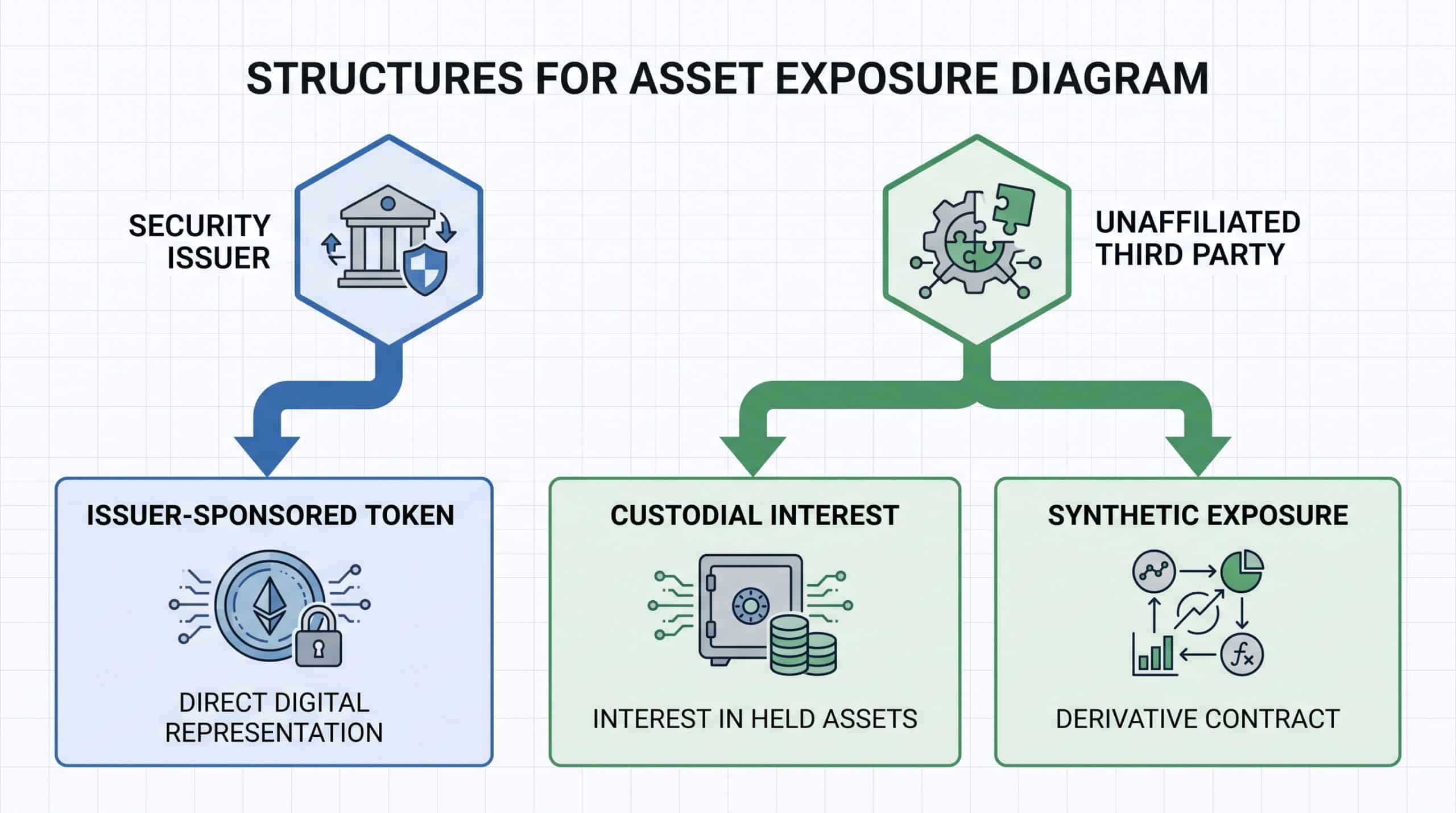
The guidance breaks digital asset tokenization into two distinct categories. Understanding this distinction matters more than any whitepaper buzzword. First, you’ve got Issuer-Led Tokenized Securities—these are tokens created by the actual securities issuer or their authorized agent.

Think of F/m Investments, which filed to maintain their Treasury ETF records on a permissioned blockchain. The blockchain becomes the registration system, but the security itself remains identical to traditional versions. This is essentially a database upgrade, nothing more revolutionary than that.

Then there’s Third-Party-Led Tokenized Securities, where someone unrelated to the issuer creates tokens representing securities. Robinhood’s European tokenized stocks perfectly illustrate this category—they track stock prices and behave like stocks. However, they’re not issued or authorized by the underlying companies.

Rumors circulated about “OpenAI tokenized equity” appearing on various platforms. OpenAI had to publicly deny any association. That response alone demonstrates the problem with unauthorized tokenization.

The $5 Billion Market That Lacked Clear Rules

The market for blockchain securities hit approximately $5 billion before this clarification arrived. A significant portion existed in regulatory gray zones that made compliance officers lose sleep.

Projects operated in jurisdictions with looser oversight or simply hoped the SEC wouldn’t notice. Security token offerings launched with vague legal opinions instead of solid regulatory footing. Billions in value floated without a proper regulatory framework protecting investors or guiding issuers.

Previous Regulatory Ambiguity and Its Consequences

The ambiguity created real damage across the industry. Promising security token offerings shut down entirely or relocated offshore because they couldn’t navigate the unclear landscape.

The consequences of this regulatory vacuum included:

  • Enforcement actions against projects that genuinely didn’t understand their obligations
  • Delisting threats from exchanges trying to avoid regulatory scrutiny
  • A chilling effect that pushed legitimate innovation to other countries
  • Investor confusion about the actual protections available for their tokenized equity holdings

This clarification matters because it eliminates the “we didn’t know” defense completely. Now there are clear categories, defined obligations, and no room for creative interpretation. The rules exist, they’re published, and ignorance is no longer an excuse for non-compliance.

3. SEC Clarifies Rules for Tokenized Securities on Blockchains: The Complete Framework

Regulatory theory meets blockchain reality—and it’s more straightforward than most people expected. The SEC’s approach doesn’t create entirely new rules for digital assets. Instead, it clarifies how existing securities laws apply when companies use blockchain technology.

The framework centers on a principle emphasized repeatedly in SEC guidance: economic substance determines security status, not the technology used to represent it. A share of stock doesn’t stop being a security just because it’s tokenized. Blockchain is simply infrastructure—a different way to record ownership and transfer rights.

How the SEC Defines Security Tokens

The SEC breaks tokenized securities into three distinct categories. Each has different compliance implications. Understanding which category applies to your project is the foundation of blockchain compliance.

Issuer-led tokenization represents the most straightforward model. This happens when a company integrates blockchain directly into its securities holder registration system. Think of it like a public corporation replacing its traditional transfer agent with blockchain.

Shares transfer on the blockchain automatically trigger official changes in the company’s shareholder register. The tokens represent direct ownership with full shareholder rights. These include voting privileges, dividend entitlements, and liquidation preferences.

Issuer-led tokens face identical requirements to traditional equity from a cryptocurrency legal framework perspective. If you’d need to file an S-1 registration statement for paper certificates, you need one for tokens. The blockchain changes the record-keeping method, not the regulatory obligations.

Custodial tokenized securities introduce an intermediary layer that creates additional considerations. In this model, a third party holds actual securities. They then issue tokens representing beneficial ownership of those custodied assets.

Custodial tokens work like warehouse receipts for securities. You don’t directly own the Apple shares—you own a claim against the custodian who owns the shares. This structure adds risks that don’t exist with direct ownership.

The SEC makes clear that these tokens usually qualify as securities themselves. Token compliance requirements depend on whether exemptions apply to both the underlying security and the tokenized representation.

Registration Requirements Under the Securities Act

Securities registration follows the same rules whether you’re issuing paper certificates or blockchain tokens. The Securities Act requirements haven’t changed—only their application to new technology.

For public offerings, issuers must file registration statements with detailed disclosures. Form S-1 remains the standard for equity securities. Form S-3 provides a shorter registration option for companies that already file Exchange Act reports.

The same class of securities can exist simultaneously in traditional and tokenized forms. A company might have some shares held through traditional transfer agents while others exist as tokens. Both represent identical economic rights and face identical regulatory treatment.

Synthetic tokenized securities represent the third category, and they’re fundamentally different from the first two. These tokens don’t convey ownership or beneficial interest in actual securities. Instead, they’re derivative contracts that track an underlying security’s price.

Someone might issue a token that provides exposure to Tesla’s stock price movement without giving holders ownership rights. These structured notes or security-based swaps fall under different regulatory frameworks. Sometimes SEC jurisdiction, sometimes CFTC oversight, depending on the specific structure.

Tokenization Model Ownership Rights Primary Risk Factor Regulatory Framework
Issuer-Led Direct shareholder rights (voting, dividends) Company performance and market risk Securities Act, Exchange Act
Custodial Beneficial interest through intermediary Custodian failure plus market risk Securities Act for tokens and underlying
Synthetic Price exposure only, no ownership Counterparty risk and derivatives exposure SEC derivatives rules or CFTC jurisdiction

Available Exemptions for Smaller Offerings

The good news? Every exemption that exists for traditional securities applies equally to tokenized versions. Blockchain technology doesn’t eliminate existing exemptions or create new ones.

Regulation D remains the most commonly used exemption for private placements. Rule 506(b) allows unlimited capital raising from accredited investors and up to 35 sophisticated non-accredited investors. Rule 506(c) permits general solicitation but restricts sales to verified accredited investors only.

Numerous security token offerings use Reg D exemptions successfully. The verification requirements don’t change. You still need third-party confirmation of accredited investor status for 506(c) offerings.

Regulation A provides a middle path between private placements and full registration. Tier 1 allows offerings up to $20 million in a 12-month period. Tier 2 permits up to $75 million.

Tier 2 offerings can trade on secondary markets after a short holding period. This makes them attractive for token projects seeking liquidity.

Other exemptions worth understanding include:

  • Regulation S: Offshore offerings to non-U.S. persons, with specific requirements to prevent flowback into U.S. markets
  • Regulation Crowdfunding: Offerings up to $5 million through registered funding portals, available to all investors with investment limits based on income and net worth
  • Section 4(a)(2): Private placements without specific safe harbor rules, requiring case-by-case analysis of facts and circumstances
  • Intrastate exemptions: Rule 147 and Rule 147A for offerings limited to residents of a single state

The critical takeaway for token compliance requirements? Using blockchain doesn’t qualify you for special treatment. The same disclosure obligations, investor verification procedures, and filing requirements apply. Technology changes the delivery mechanism, not the fundamental regulatory framework.

4. Step-by-Step Compliance Guide for Token Issuers

The regulatory compliance process for token issuers follows a predictable path. Understanding four critical phases separates successful launches from enforcement nightmares. Many projects stumble because they treat security token compliance as an afterthought rather than a foundational element.

Blockchain technology doesn’t change the destination—you’re still subject to securities law. However, it definitely changes how you get there.

This token issuance guide breaks down the journey into manageable phases. Each phase builds on the previous one. Together, they create a compliance framework that protects both your project and your investors.

Phase 1: Pre-Launch Registration and Documentation

Before you write a single line of smart contract code, nail down your offering structure. Are you the actual security issuer, or are you tokenizing existing securities? This fundamental question determines your entire regulatory compliance process.

If you’re an issuer, you’ll need standard securities documentation. That means an offering memorandum or prospectus and subscription agreements. You’ll also need investor questionnaires for accredited investor verification if you’re using Regulation D.

The blockchain component requires additional documentation that traditional offerings don’t need. You’ll need a white paper explaining the token mechanics. You’ll also need smart contract architecture documentation.

Most critically, you need clear disclosure about how the token actually conveys the security rights. Beautifully coded tokens can fail because nobody can explain the legal connection. The connection between token ownership and equity rights must be crystal clear.

Here’s something many projects miss: you need a transfer agent registered with the SEC. This applies even for blockchain securities. Some newer transfer agents specialize in digital securities and can handle both on-chain records and required SEC reporting.

Understanding the broader regulatory impact on crypto markets helps contextualize why these requirements matter.

The SEC offers several exemption pathways for your token issuance guide:

Exemption Type Investor Limits Fundraising Cap Disclosure Requirements
Regulation D (506c) Accredited investors only Unlimited Form D filing required
Regulation A General public allowed $75 million annually Offering circular required
Regulation CF General public allowed $5 million annually Basic financial statements
Regulation S Non-U.S. investors only Unlimited Offshore compliance proof

Phase 2: Implementing KYC and AML Procedures

Know Your Customer and Anti-Money Laundering procedures aren’t optional—they’re absolutely mandatory for security token compliance. You need a KYC provider that can verify investor identities. They must check sanctions lists and maintain records that satisfy regulatory scrutiny.

For U.S. offerings under Regulation D, you’re typically restricting sales to accredited investors. That requires verification of income or net worth through documentation. The KYC requirements extend beyond initial verification—you need ongoing monitoring for certain investor classes.

Here’s where blockchain changes things: your smart contract layer should enforce transfer restrictions. Tokens shouldn’t be transferable to non-verified wallets. Enforcing compliance restrictions on-chain requires thoughtful contract architecture that balances regulatory needs with blockchain functionality.

Your AML procedures need to include:

  • Customer identification program with government-issued ID verification
  • Sanctions screening against OFAC and other watchlists
  • Source of funds documentation for large investments
  • Ongoing transaction monitoring for suspicious activity
  • Suspicious Activity Report (SAR) filing procedures

Phase 3: Ongoing Reporting and Disclosure Standards

The regulatory compliance process doesn’t end at launch—it intensifies. If you’re using Regulation D, you’ll file Form D within 15 days of your first sale. Miss that deadline and you risk losing the exemption entirely.

Publicly traded tokenized securities face the same 10-K, 10-Q, and 8-K filing requirements as traditional public companies. The blockchain doesn’t exempt you from financial reporting obligations. You’re still providing audited annual financials, quarterly updates, and current reports for material events.

Third-party tokenization structures require additional risk disclosures that direct issuance doesn’t. Investors face custody risk, bankruptcy risk, and operational failure risk. Your disclosure documents need to address these specific risks clearly.

Smart Contract Security and Audit Mandates

The SEC doesn’t explicitly mandate smart contract audits in this guidance. However, you’re creating enormous liability if you deploy unaudited contracts holding investor funds or representing securities. Smart contract security isn’t just technical—it’s a critical component of your security token compliance framework.

Budget for professional smart contract audits from reputable firms like Trail of Bits, ConsenSys Diligence, or OpenZeppelin. Expect costs between $50,000 and $200,000 depending on contract complexity. That might seem steep, but it’s minimal compared to the cost of a security breach.

Your audit should cover more than just code vulnerabilities. It needs to verify that the smart contract actually implements the legal terms you’ve disclosed to investors. Token transfer restrictions, vesting schedules, voting rights—everything needs to match your offering documents exactly.

Following this token issuance guide systematically reduces your compliance risk dramatically. The regulatory landscape might seem complex, but breaking it into these phases makes it manageable. Security token compliance becomes achievable even for smaller teams with limited legal budgets.

5. Industry Impact Analysis: Statistics and Evidence

The SEC’s January announcement gave us real evidence about the security token market today. Price movements revealed important details about market maturity and investor psychology. This market impact analysis uses multiple data sources to show how regulatory clarity affects blockchain markets.

Regulatory announcements and market behavior connect in complex ways. Let me show you what the data actually reveals.

Trading Volume Changes Since the Announcement

Trading volume statistics from January 29th through early February show broader market pressure, not regulatory panic. Total cryptocurrency market capitalization dropped from approximately $2.98 trillion to $2.8 trillion within 24 hours. This represented a loss of roughly $180 billion.

Bitcoin declined to $82,138, down 6.65% and sitting 30% below its October 2025 highs. Ethereum’s drop was steeper at 7.55%, falling to $2,737. Traditional risk assets were selling off at the same time.

The S&P had just touched above 7,000 before pulling back. Microsoft posted its worst single-day performance since March 2020. Liquidations exceeded $146 million in just 24 hours from two whale addresses alone.

This wasn’t about the SEC guidance. Macro risk-off sentiment was hitting all speculative assets at once.

Security Token Offering Success Rates by Quarter

Measuring success rates for security token offerings requires looking beyond simple launch announcements. Platforms like tZERO and Polymath show that compliance makes the difference between completed raises and abandoned projects.

STOs with full security token compliance documentation have significantly higher completion rates. Those operating in regulatory gray zones struggle more. Many offerings don’t publicly disclose raise amounts, making comprehensive tracking difficult.

Fully compliant offerings complete at rates exceeding 70%. Those attempting to navigate exemptions without clear legal guidance often stall or pivot before closing. The data is still emerging, but the pattern remains consistent across multiple issuance platforms.

Metric Category Pre-Announcement Post-Announcement Percentage Change
Total Market Cap $2.98 Trillion $2.8 Trillion -6.13%
Bitcoin Price $87,962 $82,138 -6.65%
Ethereum Price $2,961 $2,737 -7.55%
24hr Liquidations $78 Million $146 Million +87.2%

How Existing Projects Are Adapting to New Rules

Projects launched before the clarification face three main paths. They can move toward full compliance, shut down operations, or explicitly exclude U.S. participants. All three strategies are playing out in real-time across different sectors.

Third-party tokenization platforms face the toughest challenges, especially those creating synthetic tokens without direct issuer partnerships. The guidance confirmed these models attract the highest regulatory scrutiny. They require additional disclosure around custody arrangements and bankruptcy risks.

Some projects are pivoting their entire business models. Others are geofencing American users while they evaluate whether compliance costs justify continued U.S. market access. The blockchain adoption rates for compliant frameworks are accelerating among established players.

Economic Impact on Blockchain Startups

The economic effects split sharply along business model lines. Companies building issuer-led tokenization infrastructure are seeing increased investor interest and funding activity. This includes transfer agents, security token compliance software, and smart contract platforms designed for regulated securities.

Several funding announcements came from these infrastructure providers in the weeks following the clarification. The market rewards companies that solve compliance problems rather than those trying to work around them.

Startups without clear paths to regulatory compliance face difficult decisions. The potential remains massive—President Trump’s August 2025 executive order theoretically opened a $10 trillion retirement savings market to cryptocurrency investments. Actual blockchain adoption rates for those institutional flows will take years and require substantial additional infrastructure buildout.

Market maturation is replacing speculative enthusiasm with institutional-grade compliance frameworks. The companies positioned to benefit build bridges between traditional finance and blockchain technology. They’re not trying to bypass existing securities laws.

6. Legal Precedents and Enforcement Actions That Shaped These Rules

Years of enforcement actions taught regulators and the industry hard lessons about digital asset regulation. The SEC’s January 2024 guidance didn’t appear overnight. It evolved from courtroom battles, settlement negotiations, and judicial criticisms that exposed gaps in regulatory clarity.

The framework we’re working with today bears the fingerprints of specific cases that forced the SEC to refine its approach. The connections are clear to anyone who’s followed the regulatory landscape.

Landmark SEC Cases Against Non-Compliant Token Projects

The foundation of all sec enforcement actions in crypto traces back to a 1946 Supreme Court case. SEC v. W.J. Howey Co. established the Howey Test, which defines an investment contract. Every major enforcement action against token projects applies this test.

The Howey Test requires an investment of money in a common enterprise. It also requires expectation of profits from others’ efforts.

Telegram’s TON token case stands out as particularly influential. The company settled with the SEC for $1.2 billion in 2020 after regulators argued their token sale was an unregistered securities offering. This case proved that even sophisticated blockchain projects can’t escape securities law by calling their tokens “utility.”

The Ripple XRP case delivered a mixed ruling in 2023 that shaped regulatory thinking. The judge ruled that institutional sales were securities, but programmatic sales to retail investors weren’t. This distinction influenced how the SEC now approaches token distribution methods in its guidance.

Real-world examples illustrate why these legal precedents matter. OpenAI publicly denied association with supposed “tokenized equity” offerings on third-party platforms. This highlighted a core problem—retail investors couldn’t distinguish between authorized issuer-led tokens and unauthorized synthetic products.

Similarly, Robinhood’s European tokenized U.S. stocks launched without issuer authorization. This represents exactly the third-party model the SEC now explicitly addresses.

Court Rulings That Influenced the Clarification

Judicial criticism played a significant role in pushing the SEC toward clearer guidance. In the Ripple case, the judge explicitly criticized the agency for not providing transparent rules. This wasn’t just legal commentary—it was a direct challenge to the SEC’s enforcement-first approach.

Courts repeatedly asked the same question: How can companies comply with rules that haven’t been clearly articulated? These securities law cases created pressure for the SEC to move beyond enforcement actions. The January 2024 guidance represents a response to those judicial demands.

The legal environment also includes enforcement beyond securities violations. The U.S. government seized over $400 million in assets related to the Helix darknet cryptocurrency mixing service. The operator was sentenced to 36 months, demonstrating how digital asset regulation intersects with anti-money laundering enforcement.

The Department of Justice finalized the forfeiture order on January 21, 2026.

How This Guidance Builds on Previous SEC Statements

The new guidance doesn’t exist in isolation—it builds on earlier attempts at clarity. The SEC’s 2019 “Framework for ‘Investment Contract’ Analysis of Digital Assets” provided initial direction. Various FinHub guidance documents added layers of interpretation.

The January 2024 document stands out for its structural specificity.

The original contribution of this guidance is its taxonomical approach. The distinction between issuer-led versus third-party-led and custodial versus synthetic models represents new categorization thinking. Previous sec enforcement actions addressed violations, but they didn’t provide this kind of systematic compliance roadmap.

This evolution reflects how legal precedents accumulate into coherent frameworks. Each enforcement action revealed what doesn’t work. Each court ruling highlighted gaps in regulatory communication.

The current guidance synthesizes those lessons into actionable categories. Blockchain companies can actually use these categories for compliance planning.

7. Essential Compliance Tools and Resources for Blockchain Companies

Staying compliant isn’t just about understanding regulations. You need the right infrastructure in place. The ecosystem supporting blockchain compliance has expanded considerably, giving companies real options for meeting SEC requirements.

Building a compliant tokenized securities offering requires partnerships with specialized service providers. You can’t do this alone. Frankly, you shouldn’t try.

Working with SEC-Registered Transfer Agents

The SEC requires you to use registered transfer agents for maintaining official shareholder records. This applies even if your securities live entirely on a blockchain. This isn’t optional—it’s a fundamental requirement under securities law.

Several transfer agents now specialize in digital securities. Pacific Stock Transfer has historically served many blockchain companies. However, they’ve experienced capacity constraints as the market has grown.

Computershare launched a digital asset division that handles tokenized offerings alongside traditional securities. VStock Transfer has built specific expertise in security token offerings. Their systems integrate with blockchain infrastructure while maintaining the compliance records the SEC expects.

Annual fees typically range from $5,000 to $25,000. This depends on shareholder count and complexity. Factor this into your budget from day one.

Blockchain Monitoring and Analytics Platforms

Demonstrating ongoing compliance means proving you’re monitoring for suspicious activity. You must also enforce transfer restrictions. That’s where specialized compliance tools become essential.

Chainalysis and Elliptic represent industry standards for AML compliance in the blockchain space. These platforms provide transaction monitoring and wallet screening against sanctions lists. They also offer risk scoring that regulators understand and accept.

Integration typically happens via API. This connects your token’s smart contract activity to their monitoring systems. Pricing starts around $10,000 annually for smaller projects, scaling up based on transaction volume.

For smart contract-level enforcement, open-source frameworks offer helpful solutions. Polymath’s PolymathCore and Tokeny’s T-REX (Token for Regulated EXchanges) let you build transfer restrictions directly into your token. These systems enforce rules at the code level.

Legal and Advisory Services for Token Compliance

You need legal counsel that understands both securities law and blockchain technology. Not every securities attorney can guide you through smart contract compliance. They may also lack experience with blockchain-specific disclosure requirements.

Law firms like Cooley, Perkins Coie, and Debevoise & Plimpton have developed dedicated digital asset practices. Their teams combine traditional securities expertise with technical blockchain knowledge.

Expect legal costs of $100,000 to $500,000 for a compliant security token offering. The range depends on whether you’re doing a private placement or public offering. It also varies based on how complex your token economics are.

Official SEC Resources and Contact Points

The SEC’s Strategic Hub for Innovation and Financial Technology (FinHub) serves as the primary resource for blockchain companies. FinHub publishes guidance documents and processes no-action letter requests. It also provides a dedicated contact point for regulatory questions.

As CFTC Chair Michael Selig mentioned, establishing clear national standards could bring blockchain firms back from offshore jurisdictions. The coordination between SEC and CFTC on regulatory resources reflects this broader policy goal.

The SEC’s Office of the Advocate for Small Business Capital Formation offers assistance specifically for smaller issuers. If you’re launching a security token offering under Regulation A+ or Regulation Crowdfunding, this office can help. They’ll guide you through the process and available regulatory resources.

These official channels provide authoritative guidance that keeps you aligned with evolving SEC interpretations. Use them—that’s what they’re there for.

8. Market Predictions and Future Regulatory Developments

I’ve tracked regulatory developments long enough to know making market predictions is risky. However, several clear trends are emerging that can’t be ignored. The consolidation phase we’re entering should accelerate growth if Congress delivers on legislation.

The question isn’t whether change is coming—it’s how fast and in what form. Right now, the Senate is advancing crypto market structure legislation. A 12-11 committee vote shows bipartisan support, which is meaningful progress after years of stalled efforts.

CFTC Chair Selig captured the optimism perfectly:

If we can set the standard in the United States, really a gold standard for crypto asset markets, we are going to see a lot of new types of products, a lot of new types of onchain markets and financial applications.

CFTC Chair Selig

Expert Forecasts for Security Token Market Growth Through 2027

The security token offerings market sits at roughly $5 billion today. Several analysts project 10-15x growth through 2027 if regulatory clarity holds. That seems achievable, though I’m skeptical of more aggressive projections some consultants throw around.

The logic is straightforward. Massive amounts of capital sit in traditional financial institutions that couldn’t touch crypto due to uncertainty. With clear rules, compliance departments can check their boxes and allocate funds.

Some firms predict $16 trillion in tokenized securities by 2030. That feels optimistic to me. But doubling or tripling from current levels over the next few years?

That’s reasonable given the institutional interest I’m seeing.

Anticipated Additional SEC Guidance on DeFi and DAOs

Chair Atkins walked back his previous suggestion about a “crypto innovation exemption” dropping this month. He said the commission needs to “think carefully” and see what Congress does first. That tells me DeFi and DAO guidance is probably 6-12 months out rather than imminent.

Expect the SEC to tackle tough questions. Does a DAO qualify as an unincorporated association that’s an issuer of securities? What disclosures are required for DeFi protocols where governance token holders control treasury funds?

The SEC is coordinating with the legislative process rather than racing ahead with exemptive orders. That’s actually a smart approach, even if it feels slow.

International Regulatory Coordination Efforts

International coordination is moving faster than I expected. We’re seeing parallel efforts across major jurisdictions that could actually harmonize into global standards. The EU has MiCA regulations rolling out.

The UK passed the Financial Services and Markets Act with crypto provisions. Dubai and Singapore created comprehensive frameworks.

Jurisdiction Framework Name Implementation Status Key Focus Area
United States SEC Guidance + Pending Legislation Active Development Security token classification
European Union MiCA (Markets in Crypto-Assets) Phased Rollout 2024-2025 Comprehensive crypto regulation
United Kingdom Financial Services and Markets Act Enacted with Ongoing Rules Stablecoin and exchange oversight
Singapore Payment Services Act Fully Implemented Licensing and consumer protection

The risk is fragmentation with different rules in different jurisdictions. But there’s enough coordination happening through bodies like IOSCO and the Financial Stability Board. We might actually get reasonably harmonized standards.

Projected Changes in Institutional Adoption Rates

Institutional adoption is the real prize here. SEC Chair Atkins advocated for 401(k) crypto access with proper guardrails. That potentially opens the $10 trillion retirement market, though actual allocation will start small.

Companies like BlackRock are already launching tokenized funds. We’re watching the traditional financial system slowly absorb blockchain rails. The Federal Reserve maintained interest rates with no cuts expected until June.

My prediction for institutional adoption by 2027: tokenized Treasury securities and money market funds become standard products. Tokenized equities remain niche but growing. The infrastructure is being built right now that will support this shift.

The timeline depends on Congress finalizing that market structure legislation. It also depends on the SEC continuing its pragmatic approach. If both happen, we’ll see meaningful institutional capital flow into security token offerings within 18-24 months.

9. Conclusion

The events of January 29, 2024 weren’t revolutionary—they were necessary. The SEC’s blockchain guidance applied existing securities law to new technology. This practical approach beats creating untested frameworks that would face years of legal battles.

Chair Atkins and CFTC Chair Selig shared a surprisingly positive outlook for digital securities. This came despite the 6.13% market decline that followed. Short-term price drops don’t reflect the long-term value of this regulatory clarity.

Institutional capital doesn’t flow into regulatory gray zones. The framework cleanly separates issuer-led tokenization from third-party efforts. Companies upgrading their cap tables or securities infrastructure follow standard compliance paths.

Third parties creating derivative tokens face appropriate disclosure requirements. Both paths now exist where confusion once lived. Tokenized securities compliance no longer requires guesswork.

The SEC provided a clear roadmap. Blockchain companies must now choose their path. They can build institutional-grade products or search for loopholes.

This choice will determine if blockchain becomes financial infrastructure or remains experimental. Based on early adoption patterns and coordinated regulatory follow-through, cautious optimism seems warranted. The foundation exists.

Execution separates winners from footnotes in regulatory enforcement actions. Companies treating this SEC blockchain guidance as permission to operate responsibly will likely succeed. They will shape the next decade of capital markets infrastructure.

FAQ

Does putting a security on blockchain exempt it from SEC registration requirements?

No, absolutely not. This is probably the biggest misconception I see repeatedly. The SEC’s January 2024 guidance made crystal clear that using blockchain technology doesn’t change the fundamental nature of a security.If your token represents ownership, dividend rights, or claims on company assets, it’s a security regardless of the underlying technology. You’ll need the same registration (S-1, Form D, Regulation A, etc.) as traditional securities, or you’ll need to qualify for an existing exemption. The blockchain is just the record-keeping infrastructure—think of it as a database upgrade, not a regulatory workaround.

What’s the difference between issuer-led and third-party tokenization?

Issuer-led tokenization is when the actual company issuing the security uses blockchain for record-keeping—like if Tesla decided to maintain its shareholder registry on blockchain. The company controls the token, and it represents direct ownership with all the same rights as traditional shares.Third-party tokenization happens when someone unrelated to the issuer creates tokens supposedly representing those securities—like platforms offering “tokenized Apple stock” without Apple’s involvement. Third-party versions add layers of risk (custodian bankruptcy, operational failure) and face much stricter disclosure requirements because tokenholders don’t directly own the underlying securities.

Can I use Regulation D to offer security tokens only to accredited investors?

Yes, Regulation D remains available for tokenized securities exactly as it works for traditional private placements. You’ll need to verify accredited investor status (income over 0,000 individually or 0,000 jointly for two years, or net worth exceeding Does putting a security on blockchain exempt it from SEC registration requirements?No, absolutely not. This is probably the biggest misconception I see repeatedly. The SEC’s January 2024 guidance made crystal clear that using blockchain technology doesn’t change the fundamental nature of a security.If your token represents ownership, dividend rights, or claims on company assets, it’s a security regardless of the underlying technology. You’ll need the same registration (S-1, Form D, Regulation A, etc.) as traditional securities, or you’ll need to qualify for an existing exemption. The blockchain is just the record-keeping infrastructure—think of it as a database upgrade, not a regulatory workaround.What’s the difference between issuer-led and third-party tokenization?Issuer-led tokenization is when the actual company issuing the security uses blockchain for record-keeping—like if Tesla decided to maintain its shareholder registry on blockchain. The company controls the token, and it represents direct ownership with all the same rights as traditional shares.Third-party tokenization happens when someone unrelated to the issuer creates tokens supposedly representing those securities—like platforms offering “tokenized Apple stock” without Apple’s involvement. Third-party versions add layers of risk (custodian bankruptcy, operational failure) and face much stricter disclosure requirements because tokenholders don’t directly own the underlying securities.Can I use Regulation D to offer security tokens only to accredited investors?Yes, Regulation D remains available for tokenized securities exactly as it works for traditional private placements. You’ll need to verify accredited investor status (income over 0,000 individually or 0,000 jointly for two years, or net worth exceeding

FAQ

Does putting a security on blockchain exempt it from SEC registration requirements?

No, absolutely not. This is probably the biggest misconception I see repeatedly. The SEC’s January 2024 guidance made crystal clear that using blockchain technology doesn’t change the fundamental nature of a security.

If your token represents ownership, dividend rights, or claims on company assets, it’s a security regardless of the underlying technology. You’ll need the same registration (S-1, Form D, Regulation A, etc.) as traditional securities, or you’ll need to qualify for an existing exemption. The blockchain is just the record-keeping infrastructure—think of it as a database upgrade, not a regulatory workaround.

What’s the difference between issuer-led and third-party tokenization?

Issuer-led tokenization is when the actual company issuing the security uses blockchain for record-keeping—like if Tesla decided to maintain its shareholder registry on blockchain. The company controls the token, and it represents direct ownership with all the same rights as traditional shares.

Third-party tokenization happens when someone unrelated to the issuer creates tokens supposedly representing those securities—like platforms offering “tokenized Apple stock” without Apple’s involvement. Third-party versions add layers of risk (custodian bankruptcy, operational failure) and face much stricter disclosure requirements because tokenholders don’t directly own the underlying securities.

Can I use Regulation D to offer security tokens only to accredited investors?

Yes, Regulation D remains available for tokenized securities exactly as it works for traditional private placements. You’ll need to verify accredited investor status (income over 0,000 individually or 0,000 jointly for two years, or net worth exceeding

FAQ

Does putting a security on blockchain exempt it from SEC registration requirements?

No, absolutely not. This is probably the biggest misconception I see repeatedly. The SEC’s January 2024 guidance made crystal clear that using blockchain technology doesn’t change the fundamental nature of a security.

If your token represents ownership, dividend rights, or claims on company assets, it’s a security regardless of the underlying technology. You’ll need the same registration (S-1, Form D, Regulation A, etc.) as traditional securities, or you’ll need to qualify for an existing exemption. The blockchain is just the record-keeping infrastructure—think of it as a database upgrade, not a regulatory workaround.

What’s the difference between issuer-led and third-party tokenization?

Issuer-led tokenization is when the actual company issuing the security uses blockchain for record-keeping—like if Tesla decided to maintain its shareholder registry on blockchain. The company controls the token, and it represents direct ownership with all the same rights as traditional shares.

Third-party tokenization happens when someone unrelated to the issuer creates tokens supposedly representing those securities—like platforms offering “tokenized Apple stock” without Apple’s involvement. Third-party versions add layers of risk (custodian bankruptcy, operational failure) and face much stricter disclosure requirements because tokenholders don’t directly own the underlying securities.

Can I use Regulation D to offer security tokens only to accredited investors?

Yes, Regulation D remains available for tokenized securities exactly as it works for traditional private placements. You’ll need to verify accredited investor status (income over $200,000 individually or $300,000 jointly for two years, or net worth exceeding $1 million excluding primary residence). You must file Form D within 15 days of first sale and maintain proper documentation.

The blockchain component requires additional considerations—your smart contracts should enforce transfer restrictions so tokens can only move to verified wallets. I’ve seen too many projects skip this enforcement layer and end up with compliance nightmares. This happens when tokens inevitably trade on secondary markets to non-accredited investors.

How much does it cost to launch a compliant security token offering?

Budget realistically for $150,000-$600,000 depending on offering complexity and structure. Here’s the breakdown from projects I’ve worked with: legal fees run $100,000-$500,000 for securities law compliance, offering documentation, and smart contract legal review. Smart contract development and audits cost $50,000-$200,000 from reputable firms like Trail of Bits or OpenZeppelin.

Transfer agent services start at $5,000-$25,000 annually. KYC/AML providers typically charge $10,000+ annually. Then you’ve got ongoing compliance costs—if you’re publicly traded, add financial reporting and audit expenses similar to traditional public companies.

Cheaper is possible for very small Regulation CF offerings. However, cutting corners on legal and security audits creates massive liability exposure.

What happens to existing security tokens that weren’t compliant before this guidance?

The guidance removed the “we didn’t know” defense, so non-compliant projects face three realistic options. First, come into compliance—register with the SEC, implement proper transfer restrictions, engage registered transfer agents, and start meeting reporting obligations. Some platforms are actively doing this.

Second, shut down and return funds to investors before facing enforcement. Third, explicitly exclude U.S. participants and operate only in jurisdictions with different rules.

What I’m seeing in practice is bifurcation—well-funded projects with institutional backing are pursuing compliance. Meanwhile, smaller projects without resources to retrofit their structure are winding down or going fully offshore. The SEC historically hasn’t pursued every violation, but this guidance significantly increases enforcement risk for projects that continue operating in gray areas.

Do smart contracts for security tokens require SEC approval or audits?

The SEC doesn’t explicitly mandate smart contract audits in the guidance, but practically speaking, you’re creating enormous liability without them. Here’s why: if your smart contract has a vulnerability that results in investor fund loss or unauthorized token transfers, you’re facing potential securities fraud claims. You also risk breach of fiduciary duty charges.

Every institutional investor or serious compliance officer will require proof of professional audit before participating. Budget for audits from established firms—expect detailed review of access controls, transfer restriction enforcement, upgrade mechanisms, and economic security.

The SEC won’t pre-approve your contracts (they don’t pre-approve anything). However, enforcement actions after failures are almost guaranteed if you skipped professional security review.

Can decentralized autonomous organizations (DAOs) issue security tokens under these rules?

The January guidance doesn’t specifically address DAOs or fully decentralized protocols. Chair Atkins acknowledged they’re still “thinking carefully” about how to regulate these structures. The challenge is that traditional securities law assumes identifiable issuers with disclosure obligations, but truly decentralized protocols may not have a clear issuer.

My read is that most DAOs with governance tokens that control treasury funds or revenue streams will likely be treated as issuers of securities. This means the DAO itself (as an unincorporated association) would face registration requirements. This creates practical problems—who signs the registration statement? Who’s liable for disclosure violations?

Expect additional SEC guidance on DeFi and DAOs within 6-12 months. Until then, projects with significant decentralization face substantial regulatory uncertainty.

Why did crypto prices drop after positive regulatory guidance was released?

The 6.65% Bitcoin drop and 7.55% Ethereum decline on January 29th tracked broader risk asset weakness, not the regulatory guidance itself. The S&P had just pulled back from briefly touching 7,000. Microsoft had its worst day since March 2020—traditional markets were weak across the board.

What this tells me is that macro factors (interest rates, economic growth concerns, overall risk appetite) still dominate crypto price action. Positive regulatory developments are necessary for long-term institutional adoption, but they don’t override immediate liquidity and risk sentiment.

Markets had likely already priced in the absence of negative regulatory developments, so the guidance landing as expected didn’t provide additional upward catalyst. The real impact will show in capital flows over quarters and years, not daily price action.

What’s the difference between custodial and synthetic tokenized securities?

Custodial tokenized securities occur when a custodian (broker-dealer, trust company) holds actual securities and issues tokens representing beneficial ownership—think of it like a warehouse receipt for stocks. You don’t directly own Apple shares; you own tokens representing a claim against the custodian who owns the shares. This adds custodian risk (bankruptcy, fraud, operational failure) that doesn’t exist with direct ownership.

Synthetic tokenized securities go further—they’re derivative contracts that track security prices without any underlying ownership. Someone issues a token tracking Apple’s stock price, but tokenholders get no voting rights, no dividends, nothing except price exposure. These are essentially structured notes or swaps regulated under different SEC rules and potentially CFTC jurisdiction.

The disclosure requirements are much stricter for synthetics. The separation from actual securities creates additional risks investors need to understand.

Can retirement accounts invest in tokenized securities after this clarification?

Technically yes, though practical implementation will take years. Chair Atkins specifically mentioned the “time is right” for retirement plans to access crypto. Trump’s executive order theoretically opened the $10 trillion retirement market.

However, the Department of Labor (which regulates ERISA retirement plans) previously warned plan fiduciaries to “exercise extreme care” with crypto investments. That guidance would need updating. Additionally, most retirement plan custodians don’t currently have infrastructure to hold tokenized securities—they’d need to develop custody solutions, update recordkeeping systems, and train staff.

My prediction is we’ll first see retirement account access to tokenized Treasury securities and money market funds (lower risk, easier to explain to participants) within 1-2 years. Tokenized equities will follow later. Actual allocation will be a small percentage of assets even when available.

How does SEC enforcement work for projects that violate these tokenized security rules?

The SEC has several enforcement tools ranging from informal warnings to federal court litigation. Typical progression starts with investigation—the SEC’s Division of Enforcement gathers information through document requests and testimony.

If they find violations, they might offer a settlement where you agree to cease operations, pay fines, and potentially disgorgement of ill-gotten gains (like Telegram’s $1.2 billion settlement). If you don’t settle, the SEC can bring administrative proceedings before an administrative law judge or file civil charges in federal court seeking injunctions, fines, and officer/director bars. Criminal referrals to the Department of Justice are possible for fraud cases.

What I’ve seen is that enforcement discretion matters enormously—the SEC can’t pursue every violation, so they tend to focus on cases with significant investor harm, intentional fraud, or projects that become high-profile examples. The January guidance increases risk because it removes ambiguity that projects previously used as defense.

What blockchain platforms are most commonly used for compliant security tokens?

Ethereum dominates the compliant security token space, primarily because it has the most mature ecosystem of compliance-focused tools and service providers. Platforms like Polymath’s PolymathCore and Tokeny’s T-REX framework provide open-source smart contracts with built-in transfer restrictions and investor whitelisting. These let you enforce “tokens only transfer to KYC-verified addresses” at the contract level.

Some projects use private or permissioned blockchains like Hyperledger or R3 Corda, particularly for institutional applications where the issuer wants more control over validator nodes. I’ve also seen security tokens on Polygon (for lower transaction costs while maintaining Ethereum compatibility) and occasionally on other chains like Tezos or Algorand.

The blockchain choice matters less than whether your smart contracts properly enforce securities law compliance requirements—transfer restrictions, lock-up periods, investor verification, etc.

million excluding primary residence). You must file Form D within 15 days of first sale and maintain proper documentation.

The blockchain component requires additional considerations—your smart contracts should enforce transfer restrictions so tokens can only move to verified wallets. I’ve seen too many projects skip this enforcement layer and end up with compliance nightmares. This happens when tokens inevitably trade on secondary markets to non-accredited investors.

How much does it cost to launch a compliant security token offering?

Budget realistically for 0,000-0,000 depending on offering complexity and structure. Here’s the breakdown from projects I’ve worked with: legal fees run 0,000-0,000 for securities law compliance, offering documentation, and smart contract legal review. Smart contract development and audits cost ,000-0,000 from reputable firms like Trail of Bits or OpenZeppelin.

Transfer agent services start at ,000-,000 annually. KYC/AML providers typically charge ,000+ annually. Then you’ve got ongoing compliance costs—if you’re publicly traded, add financial reporting and audit expenses similar to traditional public companies.

Cheaper is possible for very small Regulation CF offerings. However, cutting corners on legal and security audits creates massive liability exposure.

What happens to existing security tokens that weren’t compliant before this guidance?

The guidance removed the “we didn’t know” defense, so non-compliant projects face three realistic options. First, come into compliance—register with the SEC, implement proper transfer restrictions, engage registered transfer agents, and start meeting reporting obligations. Some platforms are actively doing this.

Second, shut down and return funds to investors before facing enforcement. Third, explicitly exclude U.S. participants and operate only in jurisdictions with different rules.

What I’m seeing in practice is bifurcation—well-funded projects with institutional backing are pursuing compliance. Meanwhile, smaller projects without resources to retrofit their structure are winding down or going fully offshore. The SEC historically hasn’t pursued every violation, but this guidance significantly increases enforcement risk for projects that continue operating in gray areas.

Do smart contracts for security tokens require SEC approval or audits?

The SEC doesn’t explicitly mandate smart contract audits in the guidance, but practically speaking, you’re creating enormous liability without them. Here’s why: if your smart contract has a vulnerability that results in investor fund loss or unauthorized token transfers, you’re facing potential securities fraud claims. You also risk breach of fiduciary duty charges.

Every institutional investor or serious compliance officer will require proof of professional audit before participating. Budget for audits from established firms—expect detailed review of access controls, transfer restriction enforcement, upgrade mechanisms, and economic security.

The SEC won’t pre-approve your contracts (they don’t pre-approve anything). However, enforcement actions after failures are almost guaranteed if you skipped professional security review.

Can decentralized autonomous organizations (DAOs) issue security tokens under these rules?

The January guidance doesn’t specifically address DAOs or fully decentralized protocols. Chair Atkins acknowledged they’re still “thinking carefully” about how to regulate these structures. The challenge is that traditional securities law assumes identifiable issuers with disclosure obligations, but truly decentralized protocols may not have a clear issuer.

My read is that most DAOs with governance tokens that control treasury funds or revenue streams will likely be treated as issuers of securities. This means the DAO itself (as an unincorporated association) would face registration requirements. This creates practical problems—who signs the registration statement? Who’s liable for disclosure violations?

Expect additional SEC guidance on DeFi and DAOs within 6-12 months. Until then, projects with significant decentralization face substantial regulatory uncertainty.

Why did crypto prices drop after positive regulatory guidance was released?

The 6.65% Bitcoin drop and 7.55% Ethereum decline on January 29th tracked broader risk asset weakness, not the regulatory guidance itself. The S&P had just pulled back from briefly touching 7,000. Microsoft had its worst day since March 2020—traditional markets were weak across the board.

What this tells me is that macro factors (interest rates, economic growth concerns, overall risk appetite) still dominate crypto price action. Positive regulatory developments are necessary for long-term institutional adoption, but they don’t override immediate liquidity and risk sentiment.

Markets had likely already priced in the absence of negative regulatory developments, so the guidance landing as expected didn’t provide additional upward catalyst. The real impact will show in capital flows over quarters and years, not daily price action.

What’s the difference between custodial and synthetic tokenized securities?

Custodial tokenized securities occur when a custodian (broker-dealer, trust company) holds actual securities and issues tokens representing beneficial ownership—think of it like a warehouse receipt for stocks. You don’t directly own Apple shares; you own tokens representing a claim against the custodian who owns the shares. This adds custodian risk (bankruptcy, fraud, operational failure) that doesn’t exist with direct ownership.

Synthetic tokenized securities go further—they’re derivative contracts that track security prices without any underlying ownership. Someone issues a token tracking Apple’s stock price, but tokenholders get no voting rights, no dividends, nothing except price exposure. These are essentially structured notes or swaps regulated under different SEC rules and potentially CFTC jurisdiction.

The disclosure requirements are much stricter for synthetics. The separation from actual securities creates additional risks investors need to understand.

Can retirement accounts invest in tokenized securities after this clarification?

Technically yes, though practical implementation will take years. Chair Atkins specifically mentioned the “time is right” for retirement plans to access crypto. Trump’s executive order theoretically opened the trillion retirement market.

However, the Department of Labor (which regulates ERISA retirement plans) previously warned plan fiduciaries to “exercise extreme care” with crypto investments. That guidance would need updating. Additionally, most retirement plan custodians don’t currently have infrastructure to hold tokenized securities—they’d need to develop custody solutions, update recordkeeping systems, and train staff.

My prediction is we’ll first see retirement account access to tokenized Treasury securities and money market funds (lower risk, easier to explain to participants) within 1-2 years. Tokenized equities will follow later. Actual allocation will be a small percentage of assets even when available.

How does SEC enforcement work for projects that violate these tokenized security rules?

The SEC has several enforcement tools ranging from informal warnings to federal court litigation. Typical progression starts with investigation—the SEC’s Division of Enforcement gathers information through document requests and testimony.

If they find violations, they might offer a settlement where you agree to cease operations, pay fines, and potentially disgorgement of ill-gotten gains (like Telegram’s

FAQ

Does putting a security on blockchain exempt it from SEC registration requirements?

No, absolutely not. This is probably the biggest misconception I see repeatedly. The SEC’s January 2024 guidance made crystal clear that using blockchain technology doesn’t change the fundamental nature of a security.

If your token represents ownership, dividend rights, or claims on company assets, it’s a security regardless of the underlying technology. You’ll need the same registration (S-1, Form D, Regulation A, etc.) as traditional securities, or you’ll need to qualify for an existing exemption. The blockchain is just the record-keeping infrastructure—think of it as a database upgrade, not a regulatory workaround.

What’s the difference between issuer-led and third-party tokenization?

Issuer-led tokenization is when the actual company issuing the security uses blockchain for record-keeping—like if Tesla decided to maintain its shareholder registry on blockchain. The company controls the token, and it represents direct ownership with all the same rights as traditional shares.

Third-party tokenization happens when someone unrelated to the issuer creates tokens supposedly representing those securities—like platforms offering “tokenized Apple stock” without Apple’s involvement. Third-party versions add layers of risk (custodian bankruptcy, operational failure) and face much stricter disclosure requirements because tokenholders don’t directly own the underlying securities.

Can I use Regulation D to offer security tokens only to accredited investors?

Yes, Regulation D remains available for tokenized securities exactly as it works for traditional private placements. You’ll need to verify accredited investor status (income over $200,000 individually or $300,000 jointly for two years, or net worth exceeding $1 million excluding primary residence). You must file Form D within 15 days of first sale and maintain proper documentation.

The blockchain component requires additional considerations—your smart contracts should enforce transfer restrictions so tokens can only move to verified wallets. I’ve seen too many projects skip this enforcement layer and end up with compliance nightmares. This happens when tokens inevitably trade on secondary markets to non-accredited investors.

How much does it cost to launch a compliant security token offering?

Budget realistically for $150,000-$600,000 depending on offering complexity and structure. Here’s the breakdown from projects I’ve worked with: legal fees run $100,000-$500,000 for securities law compliance, offering documentation, and smart contract legal review. Smart contract development and audits cost $50,000-$200,000 from reputable firms like Trail of Bits or OpenZeppelin.

Transfer agent services start at $5,000-$25,000 annually. KYC/AML providers typically charge $10,000+ annually. Then you’ve got ongoing compliance costs—if you’re publicly traded, add financial reporting and audit expenses similar to traditional public companies.

Cheaper is possible for very small Regulation CF offerings. However, cutting corners on legal and security audits creates massive liability exposure.

What happens to existing security tokens that weren’t compliant before this guidance?

The guidance removed the “we didn’t know” defense, so non-compliant projects face three realistic options. First, come into compliance—register with the SEC, implement proper transfer restrictions, engage registered transfer agents, and start meeting reporting obligations. Some platforms are actively doing this.

Second, shut down and return funds to investors before facing enforcement. Third, explicitly exclude U.S. participants and operate only in jurisdictions with different rules.

What I’m seeing in practice is bifurcation—well-funded projects with institutional backing are pursuing compliance. Meanwhile, smaller projects without resources to retrofit their structure are winding down or going fully offshore. The SEC historically hasn’t pursued every violation, but this guidance significantly increases enforcement risk for projects that continue operating in gray areas.

Do smart contracts for security tokens require SEC approval or audits?

The SEC doesn’t explicitly mandate smart contract audits in the guidance, but practically speaking, you’re creating enormous liability without them. Here’s why: if your smart contract has a vulnerability that results in investor fund loss or unauthorized token transfers, you’re facing potential securities fraud claims. You also risk breach of fiduciary duty charges.

Every institutional investor or serious compliance officer will require proof of professional audit before participating. Budget for audits from established firms—expect detailed review of access controls, transfer restriction enforcement, upgrade mechanisms, and economic security.

The SEC won’t pre-approve your contracts (they don’t pre-approve anything). However, enforcement actions after failures are almost guaranteed if you skipped professional security review.

Can decentralized autonomous organizations (DAOs) issue security tokens under these rules?

The January guidance doesn’t specifically address DAOs or fully decentralized protocols. Chair Atkins acknowledged they’re still “thinking carefully” about how to regulate these structures. The challenge is that traditional securities law assumes identifiable issuers with disclosure obligations, but truly decentralized protocols may not have a clear issuer.

My read is that most DAOs with governance tokens that control treasury funds or revenue streams will likely be treated as issuers of securities. This means the DAO itself (as an unincorporated association) would face registration requirements. This creates practical problems—who signs the registration statement? Who’s liable for disclosure violations?

Expect additional SEC guidance on DeFi and DAOs within 6-12 months. Until then, projects with significant decentralization face substantial regulatory uncertainty.

Why did crypto prices drop after positive regulatory guidance was released?

The 6.65% Bitcoin drop and 7.55% Ethereum decline on January 29th tracked broader risk asset weakness, not the regulatory guidance itself. The S&P had just pulled back from briefly touching 7,000. Microsoft had its worst day since March 2020—traditional markets were weak across the board.

What this tells me is that macro factors (interest rates, economic growth concerns, overall risk appetite) still dominate crypto price action. Positive regulatory developments are necessary for long-term institutional adoption, but they don’t override immediate liquidity and risk sentiment.

Markets had likely already priced in the absence of negative regulatory developments, so the guidance landing as expected didn’t provide additional upward catalyst. The real impact will show in capital flows over quarters and years, not daily price action.

What’s the difference between custodial and synthetic tokenized securities?

Custodial tokenized securities occur when a custodian (broker-dealer, trust company) holds actual securities and issues tokens representing beneficial ownership—think of it like a warehouse receipt for stocks. You don’t directly own Apple shares; you own tokens representing a claim against the custodian who owns the shares. This adds custodian risk (bankruptcy, fraud, operational failure) that doesn’t exist with direct ownership.

Synthetic tokenized securities go further—they’re derivative contracts that track security prices without any underlying ownership. Someone issues a token tracking Apple’s stock price, but tokenholders get no voting rights, no dividends, nothing except price exposure. These are essentially structured notes or swaps regulated under different SEC rules and potentially CFTC jurisdiction.

The disclosure requirements are much stricter for synthetics. The separation from actual securities creates additional risks investors need to understand.

Can retirement accounts invest in tokenized securities after this clarification?

Technically yes, though practical implementation will take years. Chair Atkins specifically mentioned the “time is right” for retirement plans to access crypto. Trump’s executive order theoretically opened the $10 trillion retirement market.

However, the Department of Labor (which regulates ERISA retirement plans) previously warned plan fiduciaries to “exercise extreme care” with crypto investments. That guidance would need updating. Additionally, most retirement plan custodians don’t currently have infrastructure to hold tokenized securities—they’d need to develop custody solutions, update recordkeeping systems, and train staff.

My prediction is we’ll first see retirement account access to tokenized Treasury securities and money market funds (lower risk, easier to explain to participants) within 1-2 years. Tokenized equities will follow later. Actual allocation will be a small percentage of assets even when available.

How does SEC enforcement work for projects that violate these tokenized security rules?

The SEC has several enforcement tools ranging from informal warnings to federal court litigation. Typical progression starts with investigation—the SEC’s Division of Enforcement gathers information through document requests and testimony.

If they find violations, they might offer a settlement where you agree to cease operations, pay fines, and potentially disgorgement of ill-gotten gains (like Telegram’s $1.2 billion settlement). If you don’t settle, the SEC can bring administrative proceedings before an administrative law judge or file civil charges in federal court seeking injunctions, fines, and officer/director bars. Criminal referrals to the Department of Justice are possible for fraud cases.

What I’ve seen is that enforcement discretion matters enormously—the SEC can’t pursue every violation, so they tend to focus on cases with significant investor harm, intentional fraud, or projects that become high-profile examples. The January guidance increases risk because it removes ambiguity that projects previously used as defense.

What blockchain platforms are most commonly used for compliant security tokens?

Ethereum dominates the compliant security token space, primarily because it has the most mature ecosystem of compliance-focused tools and service providers. Platforms like Polymath’s PolymathCore and Tokeny’s T-REX framework provide open-source smart contracts with built-in transfer restrictions and investor whitelisting. These let you enforce “tokens only transfer to KYC-verified addresses” at the contract level.

Some projects use private or permissioned blockchains like Hyperledger or R3 Corda, particularly for institutional applications where the issuer wants more control over validator nodes. I’ve also seen security tokens on Polygon (for lower transaction costs while maintaining Ethereum compatibility) and occasionally on other chains like Tezos or Algorand.

The blockchain choice matters less than whether your smart contracts properly enforce securities law compliance requirements—transfer restrictions, lock-up periods, investor verification, etc.

.2 billion settlement). If you don’t settle, the SEC can bring administrative proceedings before an administrative law judge or file civil charges in federal court seeking injunctions, fines, and officer/director bars. Criminal referrals to the Department of Justice are possible for fraud cases.

What I’ve seen is that enforcement discretion matters enormously—the SEC can’t pursue every violation, so they tend to focus on cases with significant investor harm, intentional fraud, or projects that become high-profile examples. The January guidance increases risk because it removes ambiguity that projects previously used as defense.

What blockchain platforms are most commonly used for compliant security tokens?

Ethereum dominates the compliant security token space, primarily because it has the most mature ecosystem of compliance-focused tools and service providers. Platforms like Polymath’s PolymathCore and Tokeny’s T-REX framework provide open-source smart contracts with built-in transfer restrictions and investor whitelisting. These let you enforce “tokens only transfer to KYC-verified addresses” at the contract level.

Some projects use private or permissioned blockchains like Hyperledger or R3 Corda, particularly for institutional applications where the issuer wants more control over validator nodes. I’ve also seen security tokens on Polygon (for lower transaction costs while maintaining Ethereum compatibility) and occasionally on other chains like Tezos or Algorand.

The blockchain choice matters less than whether your smart contracts properly enforce securities law compliance requirements—transfer restrictions, lock-up periods, investor verification, etc.

million excluding primary residence). You must file Form D within 15 days of first sale and maintain proper documentation.The blockchain component requires additional considerations—your smart contracts should enforce transfer restrictions so tokens can only move to verified wallets. I’ve seen too many projects skip this enforcement layer and end up with compliance nightmares. This happens when tokens inevitably trade on secondary markets to non-accredited investors.How much does it cost to launch a compliant security token offering?Budget realistically for 0,000-0,000 depending on offering complexity and structure. Here’s the breakdown from projects I’ve worked with: legal fees run 0,000-0,000 for securities law compliance, offering documentation, and smart contract legal review. Smart contract development and audits cost ,000-0,000 from reputable firms like Trail of Bits or OpenZeppelin.Transfer agent services start at ,000-,000 annually. KYC/AML providers typically charge ,000+ annually. Then you’ve got ongoing compliance costs—if you’re publicly traded, add financial reporting and audit expenses similar to traditional public companies.Cheaper is possible for very small Regulation CF offerings. However, cutting corners on legal and security audits creates massive liability exposure.What happens to existing security tokens that weren’t compliant before this guidance?The guidance removed the “we didn’t know” defense, so non-compliant projects face three realistic options. First, come into compliance—register with the SEC, implement proper transfer restrictions, engage registered transfer agents, and start meeting reporting obligations. Some platforms are actively doing this.Second, shut down and return funds to investors before facing enforcement. Third, explicitly exclude U.S. participants and operate only in jurisdictions with different rules.What I’m seeing in practice is bifurcation—well-funded projects with institutional backing are pursuing compliance. Meanwhile, smaller projects without resources to retrofit their structure are winding down or going fully offshore. The SEC historically hasn’t pursued every violation, but this guidance significantly increases enforcement risk for projects that continue operating in gray areas.Do smart contracts for security tokens require SEC approval or audits?The SEC doesn’t explicitly mandate smart contract audits in the guidance, but practically speaking, you’re creating enormous liability without them. Here’s why: if your smart contract has a vulnerability that results in investor fund loss or unauthorized token transfers, you’re facing potential securities fraud claims. You also risk breach of fiduciary duty charges.Every institutional investor or serious compliance officer will require proof of professional audit before participating. Budget for audits from established firms—expect detailed review of access controls, transfer restriction enforcement, upgrade mechanisms, and economic security.The SEC won’t pre-approve your contracts (they don’t pre-approve anything). However, enforcement actions after failures are almost guaranteed if you skipped professional security review.Can decentralized autonomous organizations (DAOs) issue security tokens under these rules?The January guidance doesn’t specifically address DAOs or fully decentralized protocols. Chair Atkins acknowledged they’re still “thinking carefully” about how to regulate these structures. The challenge is that traditional securities law assumes identifiable issuers with disclosure obligations, but truly decentralized protocols may not have a clear issuer.My read is that most DAOs with governance tokens that control treasury funds or revenue streams will likely be treated as issuers of securities. This means the DAO itself (as an unincorporated association) would face registration requirements. This creates practical problems—who signs the registration statement? Who’s liable for disclosure violations?Expect additional SEC guidance on DeFi and DAOs within 6-12 months. Until then, projects with significant decentralization face substantial regulatory uncertainty.Why did crypto prices drop after positive regulatory guidance was released?The 6.65% Bitcoin drop and 7.55% Ethereum decline on January 29th tracked broader risk asset weakness, not the regulatory guidance itself. The S&P had just pulled back from briefly touching 7,000. Microsoft had its worst day since March 2020—traditional markets were weak across the board.What this tells me is that macro factors (interest rates, economic growth concerns, overall risk appetite) still dominate crypto price action. Positive regulatory developments are necessary for long-term institutional adoption, but they don’t override immediate liquidity and risk sentiment.Markets had likely already priced in the absence of negative regulatory developments, so the guidance landing as expected didn’t provide additional upward catalyst. The real impact will show in capital flows over quarters and years, not daily price action.What’s the difference between custodial and synthetic tokenized securities?Custodial tokenized securities occur when a custodian (broker-dealer, trust company) holds actual securities and issues tokens representing beneficial ownership—think of it like a warehouse receipt for stocks. You don’t directly own Apple shares; you own tokens representing a claim against the custodian who owns the shares. This adds custodian risk (bankruptcy, fraud, operational failure) that doesn’t exist with direct ownership.Synthetic tokenized securities go further—they’re derivative contracts that track security prices without any underlying ownership. Someone issues a token tracking Apple’s stock price, but tokenholders get no voting rights, no dividends, nothing except price exposure. These are essentially structured notes or swaps regulated under different SEC rules and potentially CFTC jurisdiction.The disclosure requirements are much stricter for synthetics. The separation from actual securities creates additional risks investors need to understand.Can retirement accounts invest in tokenized securities after this clarification?Technically yes, though practical implementation will take years. Chair Atkins specifically mentioned the “time is right” for retirement plans to access crypto. Trump’s executive order theoretically opened the trillion retirement market.However, the Department of Labor (which regulates ERISA retirement plans) previously warned plan fiduciaries to “exercise extreme care” with crypto investments. That guidance would need updating. Additionally, most retirement plan custodians don’t currently have infrastructure to hold tokenized securities—they’d need to develop custody solutions, update recordkeeping systems, and train staff.My prediction is we’ll first see retirement account access to tokenized Treasury securities and money market funds (lower risk, easier to explain to participants) within 1-2 years. Tokenized equities will follow later. Actual allocation will be a small percentage of assets even when available.How does SEC enforcement work for projects that violate these tokenized security rules?The SEC has several enforcement tools ranging from informal warnings to federal court litigation. Typical progression starts with investigation—the SEC’s Division of Enforcement gathers information through document requests and testimony.If they find violations, they might offer a settlement where you agree to cease operations, pay fines, and potentially disgorgement of ill-gotten gains (like Telegram’s

FAQ

Does putting a security on blockchain exempt it from SEC registration requirements?

No, absolutely not. This is probably the biggest misconception I see repeatedly. The SEC’s January 2024 guidance made crystal clear that using blockchain technology doesn’t change the fundamental nature of a security.

If your token represents ownership, dividend rights, or claims on company assets, it’s a security regardless of the underlying technology. You’ll need the same registration (S-1, Form D, Regulation A, etc.) as traditional securities, or you’ll need to qualify for an existing exemption. The blockchain is just the record-keeping infrastructure—think of it as a database upgrade, not a regulatory workaround.

What’s the difference between issuer-led and third-party tokenization?

Issuer-led tokenization is when the actual company issuing the security uses blockchain for record-keeping—like if Tesla decided to maintain its shareholder registry on blockchain. The company controls the token, and it represents direct ownership with all the same rights as traditional shares.

Third-party tokenization happens when someone unrelated to the issuer creates tokens supposedly representing those securities—like platforms offering “tokenized Apple stock” without Apple’s involvement. Third-party versions add layers of risk (custodian bankruptcy, operational failure) and face much stricter disclosure requirements because tokenholders don’t directly own the underlying securities.

Can I use Regulation D to offer security tokens only to accredited investors?

Yes, Regulation D remains available for tokenized securities exactly as it works for traditional private placements. You’ll need to verify accredited investor status (income over 0,000 individually or 0,000 jointly for two years, or net worth exceeding

FAQ

Does putting a security on blockchain exempt it from SEC registration requirements?

No, absolutely not. This is probably the biggest misconception I see repeatedly. The SEC’s January 2024 guidance made crystal clear that using blockchain technology doesn’t change the fundamental nature of a security.

If your token represents ownership, dividend rights, or claims on company assets, it’s a security regardless of the underlying technology. You’ll need the same registration (S-1, Form D, Regulation A, etc.) as traditional securities, or you’ll need to qualify for an existing exemption. The blockchain is just the record-keeping infrastructure—think of it as a database upgrade, not a regulatory workaround.

What’s the difference between issuer-led and third-party tokenization?

Issuer-led tokenization is when the actual company issuing the security uses blockchain for record-keeping—like if Tesla decided to maintain its shareholder registry on blockchain. The company controls the token, and it represents direct ownership with all the same rights as traditional shares.

Third-party tokenization happens when someone unrelated to the issuer creates tokens supposedly representing those securities—like platforms offering “tokenized Apple stock” without Apple’s involvement. Third-party versions add layers of risk (custodian bankruptcy, operational failure) and face much stricter disclosure requirements because tokenholders don’t directly own the underlying securities.

Can I use Regulation D to offer security tokens only to accredited investors?

Yes, Regulation D remains available for tokenized securities exactly as it works for traditional private placements. You’ll need to verify accredited investor status (income over $200,000 individually or $300,000 jointly for two years, or net worth exceeding $1 million excluding primary residence). You must file Form D within 15 days of first sale and maintain proper documentation.

The blockchain component requires additional considerations—your smart contracts should enforce transfer restrictions so tokens can only move to verified wallets. I’ve seen too many projects skip this enforcement layer and end up with compliance nightmares. This happens when tokens inevitably trade on secondary markets to non-accredited investors.

How much does it cost to launch a compliant security token offering?

Budget realistically for $150,000-$600,000 depending on offering complexity and structure. Here’s the breakdown from projects I’ve worked with: legal fees run $100,000-$500,000 for securities law compliance, offering documentation, and smart contract legal review. Smart contract development and audits cost $50,000-$200,000 from reputable firms like Trail of Bits or OpenZeppelin.

Transfer agent services start at $5,000-$25,000 annually. KYC/AML providers typically charge $10,000+ annually. Then you’ve got ongoing compliance costs—if you’re publicly traded, add financial reporting and audit expenses similar to traditional public companies.

Cheaper is possible for very small Regulation CF offerings. However, cutting corners on legal and security audits creates massive liability exposure.

What happens to existing security tokens that weren’t compliant before this guidance?

The guidance removed the “we didn’t know” defense, so non-compliant projects face three realistic options. First, come into compliance—register with the SEC, implement proper transfer restrictions, engage registered transfer agents, and start meeting reporting obligations. Some platforms are actively doing this.

Second, shut down and return funds to investors before facing enforcement. Third, explicitly exclude U.S. participants and operate only in jurisdictions with different rules.

What I’m seeing in practice is bifurcation—well-funded projects with institutional backing are pursuing compliance. Meanwhile, smaller projects without resources to retrofit their structure are winding down or going fully offshore. The SEC historically hasn’t pursued every violation, but this guidance significantly increases enforcement risk for projects that continue operating in gray areas.

Do smart contracts for security tokens require SEC approval or audits?

The SEC doesn’t explicitly mandate smart contract audits in the guidance, but practically speaking, you’re creating enormous liability without them. Here’s why: if your smart contract has a vulnerability that results in investor fund loss or unauthorized token transfers, you’re facing potential securities fraud claims. You also risk breach of fiduciary duty charges.

Every institutional investor or serious compliance officer will require proof of professional audit before participating. Budget for audits from established firms—expect detailed review of access controls, transfer restriction enforcement, upgrade mechanisms, and economic security.

The SEC won’t pre-approve your contracts (they don’t pre-approve anything). However, enforcement actions after failures are almost guaranteed if you skipped professional security review.

Can decentralized autonomous organizations (DAOs) issue security tokens under these rules?

The January guidance doesn’t specifically address DAOs or fully decentralized protocols. Chair Atkins acknowledged they’re still “thinking carefully” about how to regulate these structures. The challenge is that traditional securities law assumes identifiable issuers with disclosure obligations, but truly decentralized protocols may not have a clear issuer.

My read is that most DAOs with governance tokens that control treasury funds or revenue streams will likely be treated as issuers of securities. This means the DAO itself (as an unincorporated association) would face registration requirements. This creates practical problems—who signs the registration statement? Who’s liable for disclosure violations?

Expect additional SEC guidance on DeFi and DAOs within 6-12 months. Until then, projects with significant decentralization face substantial regulatory uncertainty.

Why did crypto prices drop after positive regulatory guidance was released?

The 6.65% Bitcoin drop and 7.55% Ethereum decline on January 29th tracked broader risk asset weakness, not the regulatory guidance itself. The S&P had just pulled back from briefly touching 7,000. Microsoft had its worst day since March 2020—traditional markets were weak across the board.

What this tells me is that macro factors (interest rates, economic growth concerns, overall risk appetite) still dominate crypto price action. Positive regulatory developments are necessary for long-term institutional adoption, but they don’t override immediate liquidity and risk sentiment.

Markets had likely already priced in the absence of negative regulatory developments, so the guidance landing as expected didn’t provide additional upward catalyst. The real impact will show in capital flows over quarters and years, not daily price action.

What’s the difference between custodial and synthetic tokenized securities?

Custodial tokenized securities occur when a custodian (broker-dealer, trust company) holds actual securities and issues tokens representing beneficial ownership—think of it like a warehouse receipt for stocks. You don’t directly own Apple shares; you own tokens representing a claim against the custodian who owns the shares. This adds custodian risk (bankruptcy, fraud, operational failure) that doesn’t exist with direct ownership.

Synthetic tokenized securities go further—they’re derivative contracts that track security prices without any underlying ownership. Someone issues a token tracking Apple’s stock price, but tokenholders get no voting rights, no dividends, nothing except price exposure. These are essentially structured notes or swaps regulated under different SEC rules and potentially CFTC jurisdiction.

The disclosure requirements are much stricter for synthetics. The separation from actual securities creates additional risks investors need to understand.

Can retirement accounts invest in tokenized securities after this clarification?

Technically yes, though practical implementation will take years. Chair Atkins specifically mentioned the “time is right” for retirement plans to access crypto. Trump’s executive order theoretically opened the $10 trillion retirement market.

However, the Department of Labor (which regulates ERISA retirement plans) previously warned plan fiduciaries to “exercise extreme care” with crypto investments. That guidance would need updating. Additionally, most retirement plan custodians don’t currently have infrastructure to hold tokenized securities—they’d need to develop custody solutions, update recordkeeping systems, and train staff.

My prediction is we’ll first see retirement account access to tokenized Treasury securities and money market funds (lower risk, easier to explain to participants) within 1-2 years. Tokenized equities will follow later. Actual allocation will be a small percentage of assets even when available.

How does SEC enforcement work for projects that violate these tokenized security rules?

The SEC has several enforcement tools ranging from informal warnings to federal court litigation. Typical progression starts with investigation—the SEC’s Division of Enforcement gathers information through document requests and testimony.

If they find violations, they might offer a settlement where you agree to cease operations, pay fines, and potentially disgorgement of ill-gotten gains (like Telegram’s $1.2 billion settlement). If you don’t settle, the SEC can bring administrative proceedings before an administrative law judge or file civil charges in federal court seeking injunctions, fines, and officer/director bars. Criminal referrals to the Department of Justice are possible for fraud cases.

What I’ve seen is that enforcement discretion matters enormously—the SEC can’t pursue every violation, so they tend to focus on cases with significant investor harm, intentional fraud, or projects that become high-profile examples. The January guidance increases risk because it removes ambiguity that projects previously used as defense.

What blockchain platforms are most commonly used for compliant security tokens?

Ethereum dominates the compliant security token space, primarily because it has the most mature ecosystem of compliance-focused tools and service providers. Platforms like Polymath’s PolymathCore and Tokeny’s T-REX framework provide open-source smart contracts with built-in transfer restrictions and investor whitelisting. These let you enforce “tokens only transfer to KYC-verified addresses” at the contract level.

Some projects use private or permissioned blockchains like Hyperledger or R3 Corda, particularly for institutional applications where the issuer wants more control over validator nodes. I’ve also seen security tokens on Polygon (for lower transaction costs while maintaining Ethereum compatibility) and occasionally on other chains like Tezos or Algorand.

The blockchain choice matters less than whether your smart contracts properly enforce securities law compliance requirements—transfer restrictions, lock-up periods, investor verification, etc.

million excluding primary residence). You must file Form D within 15 days of first sale and maintain proper documentation.

The blockchain component requires additional considerations—your smart contracts should enforce transfer restrictions so tokens can only move to verified wallets. I’ve seen too many projects skip this enforcement layer and end up with compliance nightmares. This happens when tokens inevitably trade on secondary markets to non-accredited investors.

How much does it cost to launch a compliant security token offering?

Budget realistically for 0,000-0,000 depending on offering complexity and structure. Here’s the breakdown from projects I’ve worked with: legal fees run 0,000-0,000 for securities law compliance, offering documentation, and smart contract legal review. Smart contract development and audits cost ,000-0,000 from reputable firms like Trail of Bits or OpenZeppelin.

Transfer agent services start at ,000-,000 annually. KYC/AML providers typically charge ,000+ annually. Then you’ve got ongoing compliance costs—if you’re publicly traded, add financial reporting and audit expenses similar to traditional public companies.

Cheaper is possible for very small Regulation CF offerings. However, cutting corners on legal and security audits creates massive liability exposure.

What happens to existing security tokens that weren’t compliant before this guidance?

The guidance removed the “we didn’t know” defense, so non-compliant projects face three realistic options. First, come into compliance—register with the SEC, implement proper transfer restrictions, engage registered transfer agents, and start meeting reporting obligations. Some platforms are actively doing this.

Second, shut down and return funds to investors before facing enforcement. Third, explicitly exclude U.S. participants and operate only in jurisdictions with different rules.

What I’m seeing in practice is bifurcation—well-funded projects with institutional backing are pursuing compliance. Meanwhile, smaller projects without resources to retrofit their structure are winding down or going fully offshore. The SEC historically hasn’t pursued every violation, but this guidance significantly increases enforcement risk for projects that continue operating in gray areas.

Do smart contracts for security tokens require SEC approval or audits?

The SEC doesn’t explicitly mandate smart contract audits in the guidance, but practically speaking, you’re creating enormous liability without them. Here’s why: if your smart contract has a vulnerability that results in investor fund loss or unauthorized token transfers, you’re facing potential securities fraud claims. You also risk breach of fiduciary duty charges.

Every institutional investor or serious compliance officer will require proof of professional audit before participating. Budget for audits from established firms—expect detailed review of access controls, transfer restriction enforcement, upgrade mechanisms, and economic security.

The SEC won’t pre-approve your contracts (they don’t pre-approve anything). However, enforcement actions after failures are almost guaranteed if you skipped professional security review.

Can decentralized autonomous organizations (DAOs) issue security tokens under these rules?

The January guidance doesn’t specifically address DAOs or fully decentralized protocols. Chair Atkins acknowledged they’re still “thinking carefully” about how to regulate these structures. The challenge is that traditional securities law assumes identifiable issuers with disclosure obligations, but truly decentralized protocols may not have a clear issuer.

My read is that most DAOs with governance tokens that control treasury funds or revenue streams will likely be treated as issuers of securities. This means the DAO itself (as an unincorporated association) would face registration requirements. This creates practical problems—who signs the registration statement? Who’s liable for disclosure violations?

Expect additional SEC guidance on DeFi and DAOs within 6-12 months. Until then, projects with significant decentralization face substantial regulatory uncertainty.

Why did crypto prices drop after positive regulatory guidance was released?

The 6.65% Bitcoin drop and 7.55% Ethereum decline on January 29th tracked broader risk asset weakness, not the regulatory guidance itself. The S&P had just pulled back from briefly touching 7,000. Microsoft had its worst day since March 2020—traditional markets were weak across the board.

What this tells me is that macro factors (interest rates, economic growth concerns, overall risk appetite) still dominate crypto price action. Positive regulatory developments are necessary for long-term institutional adoption, but they don’t override immediate liquidity and risk sentiment.

Markets had likely already priced in the absence of negative regulatory developments, so the guidance landing as expected didn’t provide additional upward catalyst. The real impact will show in capital flows over quarters and years, not daily price action.

What’s the difference between custodial and synthetic tokenized securities?

Custodial tokenized securities occur when a custodian (broker-dealer, trust company) holds actual securities and issues tokens representing beneficial ownership—think of it like a warehouse receipt for stocks. You don’t directly own Apple shares; you own tokens representing a claim against the custodian who owns the shares. This adds custodian risk (bankruptcy, fraud, operational failure) that doesn’t exist with direct ownership.

Synthetic tokenized securities go further—they’re derivative contracts that track security prices without any underlying ownership. Someone issues a token tracking Apple’s stock price, but tokenholders get no voting rights, no dividends, nothing except price exposure. These are essentially structured notes or swaps regulated under different SEC rules and potentially CFTC jurisdiction.

The disclosure requirements are much stricter for synthetics. The separation from actual securities creates additional risks investors need to understand.

Can retirement accounts invest in tokenized securities after this clarification?

Technically yes, though practical implementation will take years. Chair Atkins specifically mentioned the “time is right” for retirement plans to access crypto. Trump’s executive order theoretically opened the trillion retirement market.

However, the Department of Labor (which regulates ERISA retirement plans) previously warned plan fiduciaries to “exercise extreme care” with crypto investments. That guidance would need updating. Additionally, most retirement plan custodians don’t currently have infrastructure to hold tokenized securities—they’d need to develop custody solutions, update recordkeeping systems, and train staff.

My prediction is we’ll first see retirement account access to tokenized Treasury securities and money market funds (lower risk, easier to explain to participants) within 1-2 years. Tokenized equities will follow later. Actual allocation will be a small percentage of assets even when available.

How does SEC enforcement work for projects that violate these tokenized security rules?

The SEC has several enforcement tools ranging from informal warnings to federal court litigation. Typical progression starts with investigation—the SEC’s Division of Enforcement gathers information through document requests and testimony.

If they find violations, they might offer a settlement where you agree to cease operations, pay fines, and potentially disgorgement of ill-gotten gains (like Telegram’s

FAQ

Does putting a security on blockchain exempt it from SEC registration requirements?

No, absolutely not. This is probably the biggest misconception I see repeatedly. The SEC’s January 2024 guidance made crystal clear that using blockchain technology doesn’t change the fundamental nature of a security.

If your token represents ownership, dividend rights, or claims on company assets, it’s a security regardless of the underlying technology. You’ll need the same registration (S-1, Form D, Regulation A, etc.) as traditional securities, or you’ll need to qualify for an existing exemption. The blockchain is just the record-keeping infrastructure—think of it as a database upgrade, not a regulatory workaround.

What’s the difference between issuer-led and third-party tokenization?

Issuer-led tokenization is when the actual company issuing the security uses blockchain for record-keeping—like if Tesla decided to maintain its shareholder registry on blockchain. The company controls the token, and it represents direct ownership with all the same rights as traditional shares.

Third-party tokenization happens when someone unrelated to the issuer creates tokens supposedly representing those securities—like platforms offering “tokenized Apple stock” without Apple’s involvement. Third-party versions add layers of risk (custodian bankruptcy, operational failure) and face much stricter disclosure requirements because tokenholders don’t directly own the underlying securities.

Can I use Regulation D to offer security tokens only to accredited investors?

Yes, Regulation D remains available for tokenized securities exactly as it works for traditional private placements. You’ll need to verify accredited investor status (income over $200,000 individually or $300,000 jointly for two years, or net worth exceeding $1 million excluding primary residence). You must file Form D within 15 days of first sale and maintain proper documentation.

The blockchain component requires additional considerations—your smart contracts should enforce transfer restrictions so tokens can only move to verified wallets. I’ve seen too many projects skip this enforcement layer and end up with compliance nightmares. This happens when tokens inevitably trade on secondary markets to non-accredited investors.

How much does it cost to launch a compliant security token offering?

Budget realistically for $150,000-$600,000 depending on offering complexity and structure. Here’s the breakdown from projects I’ve worked with: legal fees run $100,000-$500,000 for securities law compliance, offering documentation, and smart contract legal review. Smart contract development and audits cost $50,000-$200,000 from reputable firms like Trail of Bits or OpenZeppelin.

Transfer agent services start at $5,000-$25,000 annually. KYC/AML providers typically charge $10,000+ annually. Then you’ve got ongoing compliance costs—if you’re publicly traded, add financial reporting and audit expenses similar to traditional public companies.

Cheaper is possible for very small Regulation CF offerings. However, cutting corners on legal and security audits creates massive liability exposure.

What happens to existing security tokens that weren’t compliant before this guidance?

The guidance removed the “we didn’t know” defense, so non-compliant projects face three realistic options. First, come into compliance—register with the SEC, implement proper transfer restrictions, engage registered transfer agents, and start meeting reporting obligations. Some platforms are actively doing this.

Second, shut down and return funds to investors before facing enforcement. Third, explicitly exclude U.S. participants and operate only in jurisdictions with different rules.

What I’m seeing in practice is bifurcation—well-funded projects with institutional backing are pursuing compliance. Meanwhile, smaller projects without resources to retrofit their structure are winding down or going fully offshore. The SEC historically hasn’t pursued every violation, but this guidance significantly increases enforcement risk for projects that continue operating in gray areas.

Do smart contracts for security tokens require SEC approval or audits?

The SEC doesn’t explicitly mandate smart contract audits in the guidance, but practically speaking, you’re creating enormous liability without them. Here’s why: if your smart contract has a vulnerability that results in investor fund loss or unauthorized token transfers, you’re facing potential securities fraud claims. You also risk breach of fiduciary duty charges.

Every institutional investor or serious compliance officer will require proof of professional audit before participating. Budget for audits from established firms—expect detailed review of access controls, transfer restriction enforcement, upgrade mechanisms, and economic security.

The SEC won’t pre-approve your contracts (they don’t pre-approve anything). However, enforcement actions after failures are almost guaranteed if you skipped professional security review.

Can decentralized autonomous organizations (DAOs) issue security tokens under these rules?

The January guidance doesn’t specifically address DAOs or fully decentralized protocols. Chair Atkins acknowledged they’re still “thinking carefully” about how to regulate these structures. The challenge is that traditional securities law assumes identifiable issuers with disclosure obligations, but truly decentralized protocols may not have a clear issuer.

My read is that most DAOs with governance tokens that control treasury funds or revenue streams will likely be treated as issuers of securities. This means the DAO itself (as an unincorporated association) would face registration requirements. This creates practical problems—who signs the registration statement? Who’s liable for disclosure violations?

Expect additional SEC guidance on DeFi and DAOs within 6-12 months. Until then, projects with significant decentralization face substantial regulatory uncertainty.

Why did crypto prices drop after positive regulatory guidance was released?

The 6.65% Bitcoin drop and 7.55% Ethereum decline on January 29th tracked broader risk asset weakness, not the regulatory guidance itself. The S&P had just pulled back from briefly touching 7,000. Microsoft had its worst day since March 2020—traditional markets were weak across the board.

What this tells me is that macro factors (interest rates, economic growth concerns, overall risk appetite) still dominate crypto price action. Positive regulatory developments are necessary for long-term institutional adoption, but they don’t override immediate liquidity and risk sentiment.

Markets had likely already priced in the absence of negative regulatory developments, so the guidance landing as expected didn’t provide additional upward catalyst. The real impact will show in capital flows over quarters and years, not daily price action.

What’s the difference between custodial and synthetic tokenized securities?

Custodial tokenized securities occur when a custodian (broker-dealer, trust company) holds actual securities and issues tokens representing beneficial ownership—think of it like a warehouse receipt for stocks. You don’t directly own Apple shares; you own tokens representing a claim against the custodian who owns the shares. This adds custodian risk (bankruptcy, fraud, operational failure) that doesn’t exist with direct ownership.

Synthetic tokenized securities go further—they’re derivative contracts that track security prices without any underlying ownership. Someone issues a token tracking Apple’s stock price, but tokenholders get no voting rights, no dividends, nothing except price exposure. These are essentially structured notes or swaps regulated under different SEC rules and potentially CFTC jurisdiction.

The disclosure requirements are much stricter for synthetics. The separation from actual securities creates additional risks investors need to understand.

Can retirement accounts invest in tokenized securities after this clarification?

Technically yes, though practical implementation will take years. Chair Atkins specifically mentioned the “time is right” for retirement plans to access crypto. Trump’s executive order theoretically opened the $10 trillion retirement market.

However, the Department of Labor (which regulates ERISA retirement plans) previously warned plan fiduciaries to “exercise extreme care” with crypto investments. That guidance would need updating. Additionally, most retirement plan custodians don’t currently have infrastructure to hold tokenized securities—they’d need to develop custody solutions, update recordkeeping systems, and train staff.

My prediction is we’ll first see retirement account access to tokenized Treasury securities and money market funds (lower risk, easier to explain to participants) within 1-2 years. Tokenized equities will follow later. Actual allocation will be a small percentage of assets even when available.

How does SEC enforcement work for projects that violate these tokenized security rules?

The SEC has several enforcement tools ranging from informal warnings to federal court litigation. Typical progression starts with investigation—the SEC’s Division of Enforcement gathers information through document requests and testimony.

If they find violations, they might offer a settlement where you agree to cease operations, pay fines, and potentially disgorgement of ill-gotten gains (like Telegram’s $1.2 billion settlement). If you don’t settle, the SEC can bring administrative proceedings before an administrative law judge or file civil charges in federal court seeking injunctions, fines, and officer/director bars. Criminal referrals to the Department of Justice are possible for fraud cases.

What I’ve seen is that enforcement discretion matters enormously—the SEC can’t pursue every violation, so they tend to focus on cases with significant investor harm, intentional fraud, or projects that become high-profile examples. The January guidance increases risk because it removes ambiguity that projects previously used as defense.

What blockchain platforms are most commonly used for compliant security tokens?

Ethereum dominates the compliant security token space, primarily because it has the most mature ecosystem of compliance-focused tools and service providers. Platforms like Polymath’s PolymathCore and Tokeny’s T-REX framework provide open-source smart contracts with built-in transfer restrictions and investor whitelisting. These let you enforce “tokens only transfer to KYC-verified addresses” at the contract level.

Some projects use private or permissioned blockchains like Hyperledger or R3 Corda, particularly for institutional applications where the issuer wants more control over validator nodes. I’ve also seen security tokens on Polygon (for lower transaction costs while maintaining Ethereum compatibility) and occasionally on other chains like Tezos or Algorand.

The blockchain choice matters less than whether your smart contracts properly enforce securities law compliance requirements—transfer restrictions, lock-up periods, investor verification, etc.

.2 billion settlement). If you don’t settle, the SEC can bring administrative proceedings before an administrative law judge or file civil charges in federal court seeking injunctions, fines, and officer/director bars. Criminal referrals to the Department of Justice are possible for fraud cases.

What I’ve seen is that enforcement discretion matters enormously—the SEC can’t pursue every violation, so they tend to focus on cases with significant investor harm, intentional fraud, or projects that become high-profile examples. The January guidance increases risk because it removes ambiguity that projects previously used as defense.

What blockchain platforms are most commonly used for compliant security tokens?

Ethereum dominates the compliant security token space, primarily because it has the most mature ecosystem of compliance-focused tools and service providers. Platforms like Polymath’s PolymathCore and Tokeny’s T-REX framework provide open-source smart contracts with built-in transfer restrictions and investor whitelisting. These let you enforce “tokens only transfer to KYC-verified addresses” at the contract level.

Some projects use private or permissioned blockchains like Hyperledger or R3 Corda, particularly for institutional applications where the issuer wants more control over validator nodes. I’ve also seen security tokens on Polygon (for lower transaction costs while maintaining Ethereum compatibility) and occasionally on other chains like Tezos or Algorand.

The blockchain choice matters less than whether your smart contracts properly enforce securities law compliance requirements—transfer restrictions, lock-up periods, investor verification, etc.

.2 billion settlement). If you don’t settle, the SEC can bring administrative proceedings before an administrative law judge or file civil charges in federal court seeking injunctions, fines, and officer/director bars. Criminal referrals to the Department of Justice are possible for fraud cases.What I’ve seen is that enforcement discretion matters enormously—the SEC can’t pursue every violation, so they tend to focus on cases with significant investor harm, intentional fraud, or projects that become high-profile examples. The January guidance increases risk because it removes ambiguity that projects previously used as defense.What blockchain platforms are most commonly used for compliant security tokens?Ethereum dominates the compliant security token space, primarily because it has the most mature ecosystem of compliance-focused tools and service providers. Platforms like Polymath’s PolymathCore and Tokeny’s T-REX framework provide open-source smart contracts with built-in transfer restrictions and investor whitelisting. These let you enforce “tokens only transfer to KYC-verified addresses” at the contract level.Some projects use private or permissioned blockchains like Hyperledger or R3 Corda, particularly for institutional applications where the issuer wants more control over validator nodes. I’ve also seen security tokens on Polygon (for lower transaction costs while maintaining Ethereum compatibility) and occasionally on other chains like Tezos or Algorand.The blockchain choice matters less than whether your smart contracts properly enforce securities law compliance requirements—transfer restrictions, lock-up periods, investor verification, etc. million excluding primary residence). You must file Form D within 15 days of first sale and maintain proper documentation.The blockchain component requires additional considerations—your smart contracts should enforce transfer restrictions so tokens can only move to verified wallets. I’ve seen too many projects skip this enforcement layer and end up with compliance nightmares. This happens when tokens inevitably trade on secondary markets to non-accredited investors.

How much does it cost to launch a compliant security token offering?

Budget realistically for 0,000-0,000 depending on offering complexity and structure. Here’s the breakdown from projects I’ve worked with: legal fees run 0,000-0,000 for securities law compliance, offering documentation, and smart contract legal review. Smart contract development and audits cost ,000-0,000 from reputable firms like Trail of Bits or OpenZeppelin.Transfer agent services start at ,000-,000 annually. KYC/AML providers typically charge ,000+ annually. Then you’ve got ongoing compliance costs—if you’re publicly traded, add financial reporting and audit expenses similar to traditional public companies.Cheaper is possible for very small Regulation CF offerings. However, cutting corners on legal and security audits creates massive liability exposure.

What happens to existing security tokens that weren’t compliant before this guidance?

The guidance removed the “we didn’t know” defense, so non-compliant projects face three realistic options. First, come into compliance—register with the SEC, implement proper transfer restrictions, engage registered transfer agents, and start meeting reporting obligations. Some platforms are actively doing this.Second, shut down and return funds to investors before facing enforcement. Third, explicitly exclude U.S. participants and operate only in jurisdictions with different rules.What I’m seeing in practice is bifurcation—well-funded projects with institutional backing are pursuing compliance. Meanwhile, smaller projects without resources to retrofit their structure are winding down or going fully offshore. The SEC historically hasn’t pursued every violation, but this guidance significantly increases enforcement risk for projects that continue operating in gray areas.

Do smart contracts for security tokens require SEC approval or audits?

The SEC doesn’t explicitly mandate smart contract audits in the guidance, but practically speaking, you’re creating enormous liability without them. Here’s why: if your smart contract has a vulnerability that results in investor fund loss or unauthorized token transfers, you’re facing potential securities fraud claims. You also risk breach of fiduciary duty charges.Every institutional investor or serious compliance officer will require proof of professional audit before participating. Budget for audits from established firms—expect detailed review of access controls, transfer restriction enforcement, upgrade mechanisms, and economic security.The SEC won’t pre-approve your contracts (they don’t pre-approve anything). However, enforcement actions after failures are almost guaranteed if you skipped professional security review.

Can decentralized autonomous organizations (DAOs) issue security tokens under these rules?

The January guidance doesn’t specifically address DAOs or fully decentralized protocols. Chair Atkins acknowledged they’re still “thinking carefully” about how to regulate these structures. The challenge is that traditional securities law assumes identifiable issuers with disclosure obligations, but truly decentralized protocols may not have a clear issuer.My read is that most DAOs with governance tokens that control treasury funds or revenue streams will likely be treated as issuers of securities. This means the DAO itself (as an unincorporated association) would face registration requirements. This creates practical problems—who signs the registration statement? Who’s liable for disclosure violations?Expect additional SEC guidance on DeFi and DAOs within 6-12 months. Until then, projects with significant decentralization face substantial regulatory uncertainty.

Why did crypto prices drop after positive regulatory guidance was released?

The 6.65% Bitcoin drop and 7.55% Ethereum decline on January 29th tracked broader risk asset weakness, not the regulatory guidance itself. The S&P had just pulled back from briefly touching 7,000. Microsoft had its worst day since March 2020—traditional markets were weak across the board.What this tells me is that macro factors (interest rates, economic growth concerns, overall risk appetite) still dominate crypto price action. Positive regulatory developments are necessary for long-term institutional adoption, but they don’t override immediate liquidity and risk sentiment.Markets had likely already priced in the absence of negative regulatory developments, so the guidance landing as expected didn’t provide additional upward catalyst. The real impact will show in capital flows over quarters and years, not daily price action.

What’s the difference between custodial and synthetic tokenized securities?

Custodial tokenized securities occur when a custodian (broker-dealer, trust company) holds actual securities and issues tokens representing beneficial ownership—think of it like a warehouse receipt for stocks. You don’t directly own Apple shares; you own tokens representing a claim against the custodian who owns the shares. This adds custodian risk (bankruptcy, fraud, operational failure) that doesn’t exist with direct ownership.Synthetic tokenized securities go further—they’re derivative contracts that track security prices without any underlying ownership. Someone issues a token tracking Apple’s stock price, but tokenholders get no voting rights, no dividends, nothing except price exposure. These are essentially structured notes or swaps regulated under different SEC rules and potentially CFTC jurisdiction.The disclosure requirements are much stricter for synthetics. The separation from actual securities creates additional risks investors need to understand.

Can retirement accounts invest in tokenized securities after this clarification?

Technically yes, though practical implementation will take years. Chair Atkins specifically mentioned the “time is right” for retirement plans to access crypto. Trump’s executive order theoretically opened the trillion retirement market.However, the Department of Labor (which regulates ERISA retirement plans) previously warned plan fiduciaries to “exercise extreme care” with crypto investments. That guidance would need updating. Additionally, most retirement plan custodians don’t currently have infrastructure to hold tokenized securities—they’d need to develop custody solutions, update recordkeeping systems, and train staff.My prediction is we’ll first see retirement account access to tokenized Treasury securities and money market funds (lower risk, easier to explain to participants) within 1-2 years. Tokenized equities will follow later. Actual allocation will be a small percentage of assets even when available.

How does SEC enforcement work for projects that violate these tokenized security rules?

The SEC has several enforcement tools ranging from informal warnings to federal court litigation. Typical progression starts with investigation—the SEC’s Division of Enforcement gathers information through document requests and testimony.If they find violations, they might offer a settlement where you agree to cease operations, pay fines, and potentially disgorgement of ill-gotten gains (like Telegram’s Does putting a security on blockchain exempt it from SEC registration requirements?No, absolutely not. This is probably the biggest misconception I see repeatedly. The SEC’s January 2024 guidance made crystal clear that using blockchain technology doesn’t change the fundamental nature of a security.If your token represents ownership, dividend rights, or claims on company assets, it’s a security regardless of the underlying technology. You’ll need the same registration (S-1, Form D, Regulation A, etc.) as traditional securities, or you’ll need to qualify for an existing exemption. The blockchain is just the record-keeping infrastructure—think of it as a database upgrade, not a regulatory workaround.What’s the difference between issuer-led and third-party tokenization?Issuer-led tokenization is when the actual company issuing the security uses blockchain for record-keeping—like if Tesla decided to maintain its shareholder registry on blockchain. The company controls the token, and it represents direct ownership with all the same rights as traditional shares.Third-party tokenization happens when someone unrelated to the issuer creates tokens supposedly representing those securities—like platforms offering “tokenized Apple stock” without Apple’s involvement. Third-party versions add layers of risk (custodian bankruptcy, operational failure) and face much stricter disclosure requirements because tokenholders don’t directly own the underlying securities.Can I use Regulation D to offer security tokens only to accredited investors?Yes, Regulation D remains available for tokenized securities exactly as it works for traditional private placements. You’ll need to verify accredited investor status (income over 0,000 individually or 0,000 jointly for two years, or net worth exceeding

FAQ

Does putting a security on blockchain exempt it from SEC registration requirements?

No, absolutely not. This is probably the biggest misconception I see repeatedly. The SEC’s January 2024 guidance made crystal clear that using blockchain technology doesn’t change the fundamental nature of a security.

If your token represents ownership, dividend rights, or claims on company assets, it’s a security regardless of the underlying technology. You’ll need the same registration (S-1, Form D, Regulation A, etc.) as traditional securities, or you’ll need to qualify for an existing exemption. The blockchain is just the record-keeping infrastructure—think of it as a database upgrade, not a regulatory workaround.

What’s the difference between issuer-led and third-party tokenization?

Issuer-led tokenization is when the actual company issuing the security uses blockchain for record-keeping—like if Tesla decided to maintain its shareholder registry on blockchain. The company controls the token, and it represents direct ownership with all the same rights as traditional shares.

Third-party tokenization happens when someone unrelated to the issuer creates tokens supposedly representing those securities—like platforms offering “tokenized Apple stock” without Apple’s involvement. Third-party versions add layers of risk (custodian bankruptcy, operational failure) and face much stricter disclosure requirements because tokenholders don’t directly own the underlying securities.

Can I use Regulation D to offer security tokens only to accredited investors?

Yes, Regulation D remains available for tokenized securities exactly as it works for traditional private placements. You’ll need to verify accredited investor status (income over 0,000 individually or 0,000 jointly for two years, or net worth exceeding

FAQ

Does putting a security on blockchain exempt it from SEC registration requirements?

No, absolutely not. This is probably the biggest misconception I see repeatedly. The SEC’s January 2024 guidance made crystal clear that using blockchain technology doesn’t change the fundamental nature of a security.

If your token represents ownership, dividend rights, or claims on company assets, it’s a security regardless of the underlying technology. You’ll need the same registration (S-1, Form D, Regulation A, etc.) as traditional securities, or you’ll need to qualify for an existing exemption. The blockchain is just the record-keeping infrastructure—think of it as a database upgrade, not a regulatory workaround.

What’s the difference between issuer-led and third-party tokenization?

Issuer-led tokenization is when the actual company issuing the security uses blockchain for record-keeping—like if Tesla decided to maintain its shareholder registry on blockchain. The company controls the token, and it represents direct ownership with all the same rights as traditional shares.

Third-party tokenization happens when someone unrelated to the issuer creates tokens supposedly representing those securities—like platforms offering “tokenized Apple stock” without Apple’s involvement. Third-party versions add layers of risk (custodian bankruptcy, operational failure) and face much stricter disclosure requirements because tokenholders don’t directly own the underlying securities.

Can I use Regulation D to offer security tokens only to accredited investors?

Yes, Regulation D remains available for tokenized securities exactly as it works for traditional private placements. You’ll need to verify accredited investor status (income over $200,000 individually or $300,000 jointly for two years, or net worth exceeding $1 million excluding primary residence). You must file Form D within 15 days of first sale and maintain proper documentation.

The blockchain component requires additional considerations—your smart contracts should enforce transfer restrictions so tokens can only move to verified wallets. I’ve seen too many projects skip this enforcement layer and end up with compliance nightmares. This happens when tokens inevitably trade on secondary markets to non-accredited investors.

How much does it cost to launch a compliant security token offering?

Budget realistically for $150,000-$600,000 depending on offering complexity and structure. Here’s the breakdown from projects I’ve worked with: legal fees run $100,000-$500,000 for securities law compliance, offering documentation, and smart contract legal review. Smart contract development and audits cost $50,000-$200,000 from reputable firms like Trail of Bits or OpenZeppelin.

Transfer agent services start at $5,000-$25,000 annually. KYC/AML providers typically charge $10,000+ annually. Then you’ve got ongoing compliance costs—if you’re publicly traded, add financial reporting and audit expenses similar to traditional public companies.

Cheaper is possible for very small Regulation CF offerings. However, cutting corners on legal and security audits creates massive liability exposure.

What happens to existing security tokens that weren’t compliant before this guidance?

The guidance removed the “we didn’t know” defense, so non-compliant projects face three realistic options. First, come into compliance—register with the SEC, implement proper transfer restrictions, engage registered transfer agents, and start meeting reporting obligations. Some platforms are actively doing this.

Second, shut down and return funds to investors before facing enforcement. Third, explicitly exclude U.S. participants and operate only in jurisdictions with different rules.

What I’m seeing in practice is bifurcation—well-funded projects with institutional backing are pursuing compliance. Meanwhile, smaller projects without resources to retrofit their structure are winding down or going fully offshore. The SEC historically hasn’t pursued every violation, but this guidance significantly increases enforcement risk for projects that continue operating in gray areas.

Do smart contracts for security tokens require SEC approval or audits?

The SEC doesn’t explicitly mandate smart contract audits in the guidance, but practically speaking, you’re creating enormous liability without them. Here’s why: if your smart contract has a vulnerability that results in investor fund loss or unauthorized token transfers, you’re facing potential securities fraud claims. You also risk breach of fiduciary duty charges.

Every institutional investor or serious compliance officer will require proof of professional audit before participating. Budget for audits from established firms—expect detailed review of access controls, transfer restriction enforcement, upgrade mechanisms, and economic security.

The SEC won’t pre-approve your contracts (they don’t pre-approve anything). However, enforcement actions after failures are almost guaranteed if you skipped professional security review.

Can decentralized autonomous organizations (DAOs) issue security tokens under these rules?

The January guidance doesn’t specifically address DAOs or fully decentralized protocols. Chair Atkins acknowledged they’re still “thinking carefully” about how to regulate these structures. The challenge is that traditional securities law assumes identifiable issuers with disclosure obligations, but truly decentralized protocols may not have a clear issuer.

My read is that most DAOs with governance tokens that control treasury funds or revenue streams will likely be treated as issuers of securities. This means the DAO itself (as an unincorporated association) would face registration requirements. This creates practical problems—who signs the registration statement? Who’s liable for disclosure violations?

Expect additional SEC guidance on DeFi and DAOs within 6-12 months. Until then, projects with significant decentralization face substantial regulatory uncertainty.

Why did crypto prices drop after positive regulatory guidance was released?

The 6.65% Bitcoin drop and 7.55% Ethereum decline on January 29th tracked broader risk asset weakness, not the regulatory guidance itself. The S&P had just pulled back from briefly touching 7,000. Microsoft had its worst day since March 2020—traditional markets were weak across the board.

What this tells me is that macro factors (interest rates, economic growth concerns, overall risk appetite) still dominate crypto price action. Positive regulatory developments are necessary for long-term institutional adoption, but they don’t override immediate liquidity and risk sentiment.

Markets had likely already priced in the absence of negative regulatory developments, so the guidance landing as expected didn’t provide additional upward catalyst. The real impact will show in capital flows over quarters and years, not daily price action.

What’s the difference between custodial and synthetic tokenized securities?

Custodial tokenized securities occur when a custodian (broker-dealer, trust company) holds actual securities and issues tokens representing beneficial ownership—think of it like a warehouse receipt for stocks. You don’t directly own Apple shares; you own tokens representing a claim against the custodian who owns the shares. This adds custodian risk (bankruptcy, fraud, operational failure) that doesn’t exist with direct ownership.

Synthetic tokenized securities go further—they’re derivative contracts that track security prices without any underlying ownership. Someone issues a token tracking Apple’s stock price, but tokenholders get no voting rights, no dividends, nothing except price exposure. These are essentially structured notes or swaps regulated under different SEC rules and potentially CFTC jurisdiction.

The disclosure requirements are much stricter for synthetics. The separation from actual securities creates additional risks investors need to understand.

Can retirement accounts invest in tokenized securities after this clarification?

Technically yes, though practical implementation will take years. Chair Atkins specifically mentioned the “time is right” for retirement plans to access crypto. Trump’s executive order theoretically opened the $10 trillion retirement market.

However, the Department of Labor (which regulates ERISA retirement plans) previously warned plan fiduciaries to “exercise extreme care” with crypto investments. That guidance would need updating. Additionally, most retirement plan custodians don’t currently have infrastructure to hold tokenized securities—they’d need to develop custody solutions, update recordkeeping systems, and train staff.

My prediction is we’ll first see retirement account access to tokenized Treasury securities and money market funds (lower risk, easier to explain to participants) within 1-2 years. Tokenized equities will follow later. Actual allocation will be a small percentage of assets even when available.

How does SEC enforcement work for projects that violate these tokenized security rules?

The SEC has several enforcement tools ranging from informal warnings to federal court litigation. Typical progression starts with investigation—the SEC’s Division of Enforcement gathers information through document requests and testimony.

If they find violations, they might offer a settlement where you agree to cease operations, pay fines, and potentially disgorgement of ill-gotten gains (like Telegram’s $1.2 billion settlement). If you don’t settle, the SEC can bring administrative proceedings before an administrative law judge or file civil charges in federal court seeking injunctions, fines, and officer/director bars. Criminal referrals to the Department of Justice are possible for fraud cases.

What I’ve seen is that enforcement discretion matters enormously—the SEC can’t pursue every violation, so they tend to focus on cases with significant investor harm, intentional fraud, or projects that become high-profile examples. The January guidance increases risk because it removes ambiguity that projects previously used as defense.

What blockchain platforms are most commonly used for compliant security tokens?

Ethereum dominates the compliant security token space, primarily because it has the most mature ecosystem of compliance-focused tools and service providers. Platforms like Polymath’s PolymathCore and Tokeny’s T-REX framework provide open-source smart contracts with built-in transfer restrictions and investor whitelisting. These let you enforce “tokens only transfer to KYC-verified addresses” at the contract level.

Some projects use private or permissioned blockchains like Hyperledger or R3 Corda, particularly for institutional applications where the issuer wants more control over validator nodes. I’ve also seen security tokens on Polygon (for lower transaction costs while maintaining Ethereum compatibility) and occasionally on other chains like Tezos or Algorand.

The blockchain choice matters less than whether your smart contracts properly enforce securities law compliance requirements—transfer restrictions, lock-up periods, investor verification, etc.

million excluding primary residence). You must file Form D within 15 days of first sale and maintain proper documentation.

The blockchain component requires additional considerations—your smart contracts should enforce transfer restrictions so tokens can only move to verified wallets. I’ve seen too many projects skip this enforcement layer and end up with compliance nightmares. This happens when tokens inevitably trade on secondary markets to non-accredited investors.

How much does it cost to launch a compliant security token offering?

Budget realistically for 0,000-0,000 depending on offering complexity and structure. Here’s the breakdown from projects I’ve worked with: legal fees run 0,000-0,000 for securities law compliance, offering documentation, and smart contract legal review. Smart contract development and audits cost ,000-0,000 from reputable firms like Trail of Bits or OpenZeppelin.

Transfer agent services start at ,000-,000 annually. KYC/AML providers typically charge ,000+ annually. Then you’ve got ongoing compliance costs—if you’re publicly traded, add financial reporting and audit expenses similar to traditional public companies.

Cheaper is possible for very small Regulation CF offerings. However, cutting corners on legal and security audits creates massive liability exposure.

What happens to existing security tokens that weren’t compliant before this guidance?

The guidance removed the “we didn’t know” defense, so non-compliant projects face three realistic options. First, come into compliance—register with the SEC, implement proper transfer restrictions, engage registered transfer agents, and start meeting reporting obligations. Some platforms are actively doing this.

Second, shut down and return funds to investors before facing enforcement. Third, explicitly exclude U.S. participants and operate only in jurisdictions with different rules.

What I’m seeing in practice is bifurcation—well-funded projects with institutional backing are pursuing compliance. Meanwhile, smaller projects without resources to retrofit their structure are winding down or going fully offshore. The SEC historically hasn’t pursued every violation, but this guidance significantly increases enforcement risk for projects that continue operating in gray areas.

Do smart contracts for security tokens require SEC approval or audits?

The SEC doesn’t explicitly mandate smart contract audits in the guidance, but practically speaking, you’re creating enormous liability without them. Here’s why: if your smart contract has a vulnerability that results in investor fund loss or unauthorized token transfers, you’re facing potential securities fraud claims. You also risk breach of fiduciary duty charges.

Every institutional investor or serious compliance officer will require proof of professional audit before participating. Budget for audits from established firms—expect detailed review of access controls, transfer restriction enforcement, upgrade mechanisms, and economic security.

The SEC won’t pre-approve your contracts (they don’t pre-approve anything). However, enforcement actions after failures are almost guaranteed if you skipped professional security review.

Can decentralized autonomous organizations (DAOs) issue security tokens under these rules?

The January guidance doesn’t specifically address DAOs or fully decentralized protocols. Chair Atkins acknowledged they’re still “thinking carefully” about how to regulate these structures. The challenge is that traditional securities law assumes identifiable issuers with disclosure obligations, but truly decentralized protocols may not have a clear issuer.

My read is that most DAOs with governance tokens that control treasury funds or revenue streams will likely be treated as issuers of securities. This means the DAO itself (as an unincorporated association) would face registration requirements. This creates practical problems—who signs the registration statement? Who’s liable for disclosure violations?

Expect additional SEC guidance on DeFi and DAOs within 6-12 months. Until then, projects with significant decentralization face substantial regulatory uncertainty.

Why did crypto prices drop after positive regulatory guidance was released?

The 6.65% Bitcoin drop and 7.55% Ethereum decline on January 29th tracked broader risk asset weakness, not the regulatory guidance itself. The S&P had just pulled back from briefly touching 7,000. Microsoft had its worst day since March 2020—traditional markets were weak across the board.

What this tells me is that macro factors (interest rates, economic growth concerns, overall risk appetite) still dominate crypto price action. Positive regulatory developments are necessary for long-term institutional adoption, but they don’t override immediate liquidity and risk sentiment.

Markets had likely already priced in the absence of negative regulatory developments, so the guidance landing as expected didn’t provide additional upward catalyst. The real impact will show in capital flows over quarters and years, not daily price action.

What’s the difference between custodial and synthetic tokenized securities?

Custodial tokenized securities occur when a custodian (broker-dealer, trust company) holds actual securities and issues tokens representing beneficial ownership—think of it like a warehouse receipt for stocks. You don’t directly own Apple shares; you own tokens representing a claim against the custodian who owns the shares. This adds custodian risk (bankruptcy, fraud, operational failure) that doesn’t exist with direct ownership.

Synthetic tokenized securities go further—they’re derivative contracts that track security prices without any underlying ownership. Someone issues a token tracking Apple’s stock price, but tokenholders get no voting rights, no dividends, nothing except price exposure. These are essentially structured notes or swaps regulated under different SEC rules and potentially CFTC jurisdiction.

The disclosure requirements are much stricter for synthetics. The separation from actual securities creates additional risks investors need to understand.

Can retirement accounts invest in tokenized securities after this clarification?

Technically yes, though practical implementation will take years. Chair Atkins specifically mentioned the “time is right” for retirement plans to access crypto. Trump’s executive order theoretically opened the trillion retirement market.

However, the Department of Labor (which regulates ERISA retirement plans) previously warned plan fiduciaries to “exercise extreme care” with crypto investments. That guidance would need updating. Additionally, most retirement plan custodians don’t currently have infrastructure to hold tokenized securities—they’d need to develop custody solutions, update recordkeeping systems, and train staff.

My prediction is we’ll first see retirement account access to tokenized Treasury securities and money market funds (lower risk, easier to explain to participants) within 1-2 years. Tokenized equities will follow later. Actual allocation will be a small percentage of assets even when available.

How does SEC enforcement work for projects that violate these tokenized security rules?

The SEC has several enforcement tools ranging from informal warnings to federal court litigation. Typical progression starts with investigation—the SEC’s Division of Enforcement gathers information through document requests and testimony.

If they find violations, they might offer a settlement where you agree to cease operations, pay fines, and potentially disgorgement of ill-gotten gains (like Telegram’s

FAQ

Does putting a security on blockchain exempt it from SEC registration requirements?

No, absolutely not. This is probably the biggest misconception I see repeatedly. The SEC’s January 2024 guidance made crystal clear that using blockchain technology doesn’t change the fundamental nature of a security.

If your token represents ownership, dividend rights, or claims on company assets, it’s a security regardless of the underlying technology. You’ll need the same registration (S-1, Form D, Regulation A, etc.) as traditional securities, or you’ll need to qualify for an existing exemption. The blockchain is just the record-keeping infrastructure—think of it as a database upgrade, not a regulatory workaround.

What’s the difference between issuer-led and third-party tokenization?

Issuer-led tokenization is when the actual company issuing the security uses blockchain for record-keeping—like if Tesla decided to maintain its shareholder registry on blockchain. The company controls the token, and it represents direct ownership with all the same rights as traditional shares.

Third-party tokenization happens when someone unrelated to the issuer creates tokens supposedly representing those securities—like platforms offering “tokenized Apple stock” without Apple’s involvement. Third-party versions add layers of risk (custodian bankruptcy, operational failure) and face much stricter disclosure requirements because tokenholders don’t directly own the underlying securities.

Can I use Regulation D to offer security tokens only to accredited investors?

Yes, Regulation D remains available for tokenized securities exactly as it works for traditional private placements. You’ll need to verify accredited investor status (income over $200,000 individually or $300,000 jointly for two years, or net worth exceeding $1 million excluding primary residence). You must file Form D within 15 days of first sale and maintain proper documentation.

The blockchain component requires additional considerations—your smart contracts should enforce transfer restrictions so tokens can only move to verified wallets. I’ve seen too many projects skip this enforcement layer and end up with compliance nightmares. This happens when tokens inevitably trade on secondary markets to non-accredited investors.

How much does it cost to launch a compliant security token offering?

Budget realistically for $150,000-$600,000 depending on offering complexity and structure. Here’s the breakdown from projects I’ve worked with: legal fees run $100,000-$500,000 for securities law compliance, offering documentation, and smart contract legal review. Smart contract development and audits cost $50,000-$200,000 from reputable firms like Trail of Bits or OpenZeppelin.

Transfer agent services start at $5,000-$25,000 annually. KYC/AML providers typically charge $10,000+ annually. Then you’ve got ongoing compliance costs—if you’re publicly traded, add financial reporting and audit expenses similar to traditional public companies.

Cheaper is possible for very small Regulation CF offerings. However, cutting corners on legal and security audits creates massive liability exposure.

What happens to existing security tokens that weren’t compliant before this guidance?

The guidance removed the “we didn’t know” defense, so non-compliant projects face three realistic options. First, come into compliance—register with the SEC, implement proper transfer restrictions, engage registered transfer agents, and start meeting reporting obligations. Some platforms are actively doing this.

Second, shut down and return funds to investors before facing enforcement. Third, explicitly exclude U.S. participants and operate only in jurisdictions with different rules.

What I’m seeing in practice is bifurcation—well-funded projects with institutional backing are pursuing compliance. Meanwhile, smaller projects without resources to retrofit their structure are winding down or going fully offshore. The SEC historically hasn’t pursued every violation, but this guidance significantly increases enforcement risk for projects that continue operating in gray areas.

Do smart contracts for security tokens require SEC approval or audits?

The SEC doesn’t explicitly mandate smart contract audits in the guidance, but practically speaking, you’re creating enormous liability without them. Here’s why: if your smart contract has a vulnerability that results in investor fund loss or unauthorized token transfers, you’re facing potential securities fraud claims. You also risk breach of fiduciary duty charges.

Every institutional investor or serious compliance officer will require proof of professional audit before participating. Budget for audits from established firms—expect detailed review of access controls, transfer restriction enforcement, upgrade mechanisms, and economic security.

The SEC won’t pre-approve your contracts (they don’t pre-approve anything). However, enforcement actions after failures are almost guaranteed if you skipped professional security review.

Can decentralized autonomous organizations (DAOs) issue security tokens under these rules?

The January guidance doesn’t specifically address DAOs or fully decentralized protocols. Chair Atkins acknowledged they’re still “thinking carefully” about how to regulate these structures. The challenge is that traditional securities law assumes identifiable issuers with disclosure obligations, but truly decentralized protocols may not have a clear issuer.

My read is that most DAOs with governance tokens that control treasury funds or revenue streams will likely be treated as issuers of securities. This means the DAO itself (as an unincorporated association) would face registration requirements. This creates practical problems—who signs the registration statement? Who’s liable for disclosure violations?

Expect additional SEC guidance on DeFi and DAOs within 6-12 months. Until then, projects with significant decentralization face substantial regulatory uncertainty.

Why did crypto prices drop after positive regulatory guidance was released?

The 6.65% Bitcoin drop and 7.55% Ethereum decline on January 29th tracked broader risk asset weakness, not the regulatory guidance itself. The S&P had just pulled back from briefly touching 7,000. Microsoft had its worst day since March 2020—traditional markets were weak across the board.

What this tells me is that macro factors (interest rates, economic growth concerns, overall risk appetite) still dominate crypto price action. Positive regulatory developments are necessary for long-term institutional adoption, but they don’t override immediate liquidity and risk sentiment.

Markets had likely already priced in the absence of negative regulatory developments, so the guidance landing as expected didn’t provide additional upward catalyst. The real impact will show in capital flows over quarters and years, not daily price action.

What’s the difference between custodial and synthetic tokenized securities?

Custodial tokenized securities occur when a custodian (broker-dealer, trust company) holds actual securities and issues tokens representing beneficial ownership—think of it like a warehouse receipt for stocks. You don’t directly own Apple shares; you own tokens representing a claim against the custodian who owns the shares. This adds custodian risk (bankruptcy, fraud, operational failure) that doesn’t exist with direct ownership.

Synthetic tokenized securities go further—they’re derivative contracts that track security prices without any underlying ownership. Someone issues a token tracking Apple’s stock price, but tokenholders get no voting rights, no dividends, nothing except price exposure. These are essentially structured notes or swaps regulated under different SEC rules and potentially CFTC jurisdiction.

The disclosure requirements are much stricter for synthetics. The separation from actual securities creates additional risks investors need to understand.

Can retirement accounts invest in tokenized securities after this clarification?

Technically yes, though practical implementation will take years. Chair Atkins specifically mentioned the “time is right” for retirement plans to access crypto. Trump’s executive order theoretically opened the $10 trillion retirement market.

However, the Department of Labor (which regulates ERISA retirement plans) previously warned plan fiduciaries to “exercise extreme care” with crypto investments. That guidance would need updating. Additionally, most retirement plan custodians don’t currently have infrastructure to hold tokenized securities—they’d need to develop custody solutions, update recordkeeping systems, and train staff.

My prediction is we’ll first see retirement account access to tokenized Treasury securities and money market funds (lower risk, easier to explain to participants) within 1-2 years. Tokenized equities will follow later. Actual allocation will be a small percentage of assets even when available.

How does SEC enforcement work for projects that violate these tokenized security rules?

The SEC has several enforcement tools ranging from informal warnings to federal court litigation. Typical progression starts with investigation—the SEC’s Division of Enforcement gathers information through document requests and testimony.

If they find violations, they might offer a settlement where you agree to cease operations, pay fines, and potentially disgorgement of ill-gotten gains (like Telegram’s $1.2 billion settlement). If you don’t settle, the SEC can bring administrative proceedings before an administrative law judge or file civil charges in federal court seeking injunctions, fines, and officer/director bars. Criminal referrals to the Department of Justice are possible for fraud cases.

What I’ve seen is that enforcement discretion matters enormously—the SEC can’t pursue every violation, so they tend to focus on cases with significant investor harm, intentional fraud, or projects that become high-profile examples. The January guidance increases risk because it removes ambiguity that projects previously used as defense.

What blockchain platforms are most commonly used for compliant security tokens?

Ethereum dominates the compliant security token space, primarily because it has the most mature ecosystem of compliance-focused tools and service providers. Platforms like Polymath’s PolymathCore and Tokeny’s T-REX framework provide open-source smart contracts with built-in transfer restrictions and investor whitelisting. These let you enforce “tokens only transfer to KYC-verified addresses” at the contract level.

Some projects use private or permissioned blockchains like Hyperledger or R3 Corda, particularly for institutional applications where the issuer wants more control over validator nodes. I’ve also seen security tokens on Polygon (for lower transaction costs while maintaining Ethereum compatibility) and occasionally on other chains like Tezos or Algorand.

The blockchain choice matters less than whether your smart contracts properly enforce securities law compliance requirements—transfer restrictions, lock-up periods, investor verification, etc.

.2 billion settlement). If you don’t settle, the SEC can bring administrative proceedings before an administrative law judge or file civil charges in federal court seeking injunctions, fines, and officer/director bars. Criminal referrals to the Department of Justice are possible for fraud cases.

What I’ve seen is that enforcement discretion matters enormously—the SEC can’t pursue every violation, so they tend to focus on cases with significant investor harm, intentional fraud, or projects that become high-profile examples. The January guidance increases risk because it removes ambiguity that projects previously used as defense.

What blockchain platforms are most commonly used for compliant security tokens?

Ethereum dominates the compliant security token space, primarily because it has the most mature ecosystem of compliance-focused tools and service providers. Platforms like Polymath’s PolymathCore and Tokeny’s T-REX framework provide open-source smart contracts with built-in transfer restrictions and investor whitelisting. These let you enforce “tokens only transfer to KYC-verified addresses” at the contract level.

Some projects use private or permissioned blockchains like Hyperledger or R3 Corda, particularly for institutional applications where the issuer wants more control over validator nodes. I’ve also seen security tokens on Polygon (for lower transaction costs while maintaining Ethereum compatibility) and occasionally on other chains like Tezos or Algorand.

The blockchain choice matters less than whether your smart contracts properly enforce securities law compliance requirements—transfer restrictions, lock-up periods, investor verification, etc.

million excluding primary residence). You must file Form D within 15 days of first sale and maintain proper documentation.The blockchain component requires additional considerations—your smart contracts should enforce transfer restrictions so tokens can only move to verified wallets. I’ve seen too many projects skip this enforcement layer and end up with compliance nightmares. This happens when tokens inevitably trade on secondary markets to non-accredited investors.How much does it cost to launch a compliant security token offering?Budget realistically for 0,000-0,000 depending on offering complexity and structure. Here’s the breakdown from projects I’ve worked with: legal fees run 0,000-0,000 for securities law compliance, offering documentation, and smart contract legal review. Smart contract development and audits cost ,000-0,000 from reputable firms like Trail of Bits or OpenZeppelin.Transfer agent services start at ,000-,000 annually. KYC/AML providers typically charge ,000+ annually. Then you’ve got ongoing compliance costs—if you’re publicly traded, add financial reporting and audit expenses similar to traditional public companies.Cheaper is possible for very small Regulation CF offerings. However, cutting corners on legal and security audits creates massive liability exposure.What happens to existing security tokens that weren’t compliant before this guidance?The guidance removed the “we didn’t know” defense, so non-compliant projects face three realistic options. First, come into compliance—register with the SEC, implement proper transfer restrictions, engage registered transfer agents, and start meeting reporting obligations. Some platforms are actively doing this.Second, shut down and return funds to investors before facing enforcement. Third, explicitly exclude U.S. participants and operate only in jurisdictions with different rules.What I’m seeing in practice is bifurcation—well-funded projects with institutional backing are pursuing compliance. Meanwhile, smaller projects without resources to retrofit their structure are winding down or going fully offshore. The SEC historically hasn’t pursued every violation, but this guidance significantly increases enforcement risk for projects that continue operating in gray areas.Do smart contracts for security tokens require SEC approval or audits?The SEC doesn’t explicitly mandate smart contract audits in the guidance, but practically speaking, you’re creating enormous liability without them. Here’s why: if your smart contract has a vulnerability that results in investor fund loss or unauthorized token transfers, you’re facing potential securities fraud claims. You also risk breach of fiduciary duty charges.Every institutional investor or serious compliance officer will require proof of professional audit before participating. Budget for audits from established firms—expect detailed review of access controls, transfer restriction enforcement, upgrade mechanisms, and economic security.The SEC won’t pre-approve your contracts (they don’t pre-approve anything). However, enforcement actions after failures are almost guaranteed if you skipped professional security review.Can decentralized autonomous organizations (DAOs) issue security tokens under these rules?The January guidance doesn’t specifically address DAOs or fully decentralized protocols. Chair Atkins acknowledged they’re still “thinking carefully” about how to regulate these structures. The challenge is that traditional securities law assumes identifiable issuers with disclosure obligations, but truly decentralized protocols may not have a clear issuer.My read is that most DAOs with governance tokens that control treasury funds or revenue streams will likely be treated as issuers of securities. This means the DAO itself (as an unincorporated association) would face registration requirements. This creates practical problems—who signs the registration statement? Who’s liable for disclosure violations?Expect additional SEC guidance on DeFi and DAOs within 6-12 months. Until then, projects with significant decentralization face substantial regulatory uncertainty.Why did crypto prices drop after positive regulatory guidance was released?The 6.65% Bitcoin drop and 7.55% Ethereum decline on January 29th tracked broader risk asset weakness, not the regulatory guidance itself. The S&P had just pulled back from briefly touching 7,000. Microsoft had its worst day since March 2020—traditional markets were weak across the board.What this tells me is that macro factors (interest rates, economic growth concerns, overall risk appetite) still dominate crypto price action. Positive regulatory developments are necessary for long-term institutional adoption, but they don’t override immediate liquidity and risk sentiment.Markets had likely already priced in the absence of negative regulatory developments, so the guidance landing as expected didn’t provide additional upward catalyst. The real impact will show in capital flows over quarters and years, not daily price action.What’s the difference between custodial and synthetic tokenized securities?Custodial tokenized securities occur when a custodian (broker-dealer, trust company) holds actual securities and issues tokens representing beneficial ownership—think of it like a warehouse receipt for stocks. You don’t directly own Apple shares; you own tokens representing a claim against the custodian who owns the shares. This adds custodian risk (bankruptcy, fraud, operational failure) that doesn’t exist with direct ownership.Synthetic tokenized securities go further—they’re derivative contracts that track security prices without any underlying ownership. Someone issues a token tracking Apple’s stock price, but tokenholders get no voting rights, no dividends, nothing except price exposure. These are essentially structured notes or swaps regulated under different SEC rules and potentially CFTC jurisdiction.The disclosure requirements are much stricter for synthetics. The separation from actual securities creates additional risks investors need to understand.Can retirement accounts invest in tokenized securities after this clarification?Technically yes, though practical implementation will take years. Chair Atkins specifically mentioned the “time is right” for retirement plans to access crypto. Trump’s executive order theoretically opened the trillion retirement market.However, the Department of Labor (which regulates ERISA retirement plans) previously warned plan fiduciaries to “exercise extreme care” with crypto investments. That guidance would need updating. Additionally, most retirement plan custodians don’t currently have infrastructure to hold tokenized securities—they’d need to develop custody solutions, update recordkeeping systems, and train staff.My prediction is we’ll first see retirement account access to tokenized Treasury securities and money market funds (lower risk, easier to explain to participants) within 1-2 years. Tokenized equities will follow later. Actual allocation will be a small percentage of assets even when available.How does SEC enforcement work for projects that violate these tokenized security rules?The SEC has several enforcement tools ranging from informal warnings to federal court litigation. Typical progression starts with investigation—the SEC’s Division of Enforcement gathers information through document requests and testimony.If they find violations, they might offer a settlement where you agree to cease operations, pay fines, and potentially disgorgement of ill-gotten gains (like Telegram’s

FAQ

Does putting a security on blockchain exempt it from SEC registration requirements?

No, absolutely not. This is probably the biggest misconception I see repeatedly. The SEC’s January 2024 guidance made crystal clear that using blockchain technology doesn’t change the fundamental nature of a security.

If your token represents ownership, dividend rights, or claims on company assets, it’s a security regardless of the underlying technology. You’ll need the same registration (S-1, Form D, Regulation A, etc.) as traditional securities, or you’ll need to qualify for an existing exemption. The blockchain is just the record-keeping infrastructure—think of it as a database upgrade, not a regulatory workaround.

What’s the difference between issuer-led and third-party tokenization?

Issuer-led tokenization is when the actual company issuing the security uses blockchain for record-keeping—like if Tesla decided to maintain its shareholder registry on blockchain. The company controls the token, and it represents direct ownership with all the same rights as traditional shares.

Third-party tokenization happens when someone unrelated to the issuer creates tokens supposedly representing those securities—like platforms offering “tokenized Apple stock” without Apple’s involvement. Third-party versions add layers of risk (custodian bankruptcy, operational failure) and face much stricter disclosure requirements because tokenholders don’t directly own the underlying securities.

Can I use Regulation D to offer security tokens only to accredited investors?

Yes, Regulation D remains available for tokenized securities exactly as it works for traditional private placements. You’ll need to verify accredited investor status (income over 0,000 individually or 0,000 jointly for two years, or net worth exceeding

FAQ

Does putting a security on blockchain exempt it from SEC registration requirements?

No, absolutely not. This is probably the biggest misconception I see repeatedly. The SEC’s January 2024 guidance made crystal clear that using blockchain technology doesn’t change the fundamental nature of a security.

If your token represents ownership, dividend rights, or claims on company assets, it’s a security regardless of the underlying technology. You’ll need the same registration (S-1, Form D, Regulation A, etc.) as traditional securities, or you’ll need to qualify for an existing exemption. The blockchain is just the record-keeping infrastructure—think of it as a database upgrade, not a regulatory workaround.

What’s the difference between issuer-led and third-party tokenization?

Issuer-led tokenization is when the actual company issuing the security uses blockchain for record-keeping—like if Tesla decided to maintain its shareholder registry on blockchain. The company controls the token, and it represents direct ownership with all the same rights as traditional shares.

Third-party tokenization happens when someone unrelated to the issuer creates tokens supposedly representing those securities—like platforms offering “tokenized Apple stock” without Apple’s involvement. Third-party versions add layers of risk (custodian bankruptcy, operational failure) and face much stricter disclosure requirements because tokenholders don’t directly own the underlying securities.

Can I use Regulation D to offer security tokens only to accredited investors?

Yes, Regulation D remains available for tokenized securities exactly as it works for traditional private placements. You’ll need to verify accredited investor status (income over $200,000 individually or $300,000 jointly for two years, or net worth exceeding $1 million excluding primary residence). You must file Form D within 15 days of first sale and maintain proper documentation.

The blockchain component requires additional considerations—your smart contracts should enforce transfer restrictions so tokens can only move to verified wallets. I’ve seen too many projects skip this enforcement layer and end up with compliance nightmares. This happens when tokens inevitably trade on secondary markets to non-accredited investors.

How much does it cost to launch a compliant security token offering?

Budget realistically for $150,000-$600,000 depending on offering complexity and structure. Here’s the breakdown from projects I’ve worked with: legal fees run $100,000-$500,000 for securities law compliance, offering documentation, and smart contract legal review. Smart contract development and audits cost $50,000-$200,000 from reputable firms like Trail of Bits or OpenZeppelin.

Transfer agent services start at $5,000-$25,000 annually. KYC/AML providers typically charge $10,000+ annually. Then you’ve got ongoing compliance costs—if you’re publicly traded, add financial reporting and audit expenses similar to traditional public companies.

Cheaper is possible for very small Regulation CF offerings. However, cutting corners on legal and security audits creates massive liability exposure.

What happens to existing security tokens that weren’t compliant before this guidance?

The guidance removed the “we didn’t know” defense, so non-compliant projects face three realistic options. First, come into compliance—register with the SEC, implement proper transfer restrictions, engage registered transfer agents, and start meeting reporting obligations. Some platforms are actively doing this.

Second, shut down and return funds to investors before facing enforcement. Third, explicitly exclude U.S. participants and operate only in jurisdictions with different rules.

What I’m seeing in practice is bifurcation—well-funded projects with institutional backing are pursuing compliance. Meanwhile, smaller projects without resources to retrofit their structure are winding down or going fully offshore. The SEC historically hasn’t pursued every violation, but this guidance significantly increases enforcement risk for projects that continue operating in gray areas.

Do smart contracts for security tokens require SEC approval or audits?

The SEC doesn’t explicitly mandate smart contract audits in the guidance, but practically speaking, you’re creating enormous liability without them. Here’s why: if your smart contract has a vulnerability that results in investor fund loss or unauthorized token transfers, you’re facing potential securities fraud claims. You also risk breach of fiduciary duty charges.

Every institutional investor or serious compliance officer will require proof of professional audit before participating. Budget for audits from established firms—expect detailed review of access controls, transfer restriction enforcement, upgrade mechanisms, and economic security.

The SEC won’t pre-approve your contracts (they don’t pre-approve anything). However, enforcement actions after failures are almost guaranteed if you skipped professional security review.

Can decentralized autonomous organizations (DAOs) issue security tokens under these rules?

The January guidance doesn’t specifically address DAOs or fully decentralized protocols. Chair Atkins acknowledged they’re still “thinking carefully” about how to regulate these structures. The challenge is that traditional securities law assumes identifiable issuers with disclosure obligations, but truly decentralized protocols may not have a clear issuer.

My read is that most DAOs with governance tokens that control treasury funds or revenue streams will likely be treated as issuers of securities. This means the DAO itself (as an unincorporated association) would face registration requirements. This creates practical problems—who signs the registration statement? Who’s liable for disclosure violations?

Expect additional SEC guidance on DeFi and DAOs within 6-12 months. Until then, projects with significant decentralization face substantial regulatory uncertainty.

Why did crypto prices drop after positive regulatory guidance was released?

The 6.65% Bitcoin drop and 7.55% Ethereum decline on January 29th tracked broader risk asset weakness, not the regulatory guidance itself. The S&P had just pulled back from briefly touching 7,000. Microsoft had its worst day since March 2020—traditional markets were weak across the board.

What this tells me is that macro factors (interest rates, economic growth concerns, overall risk appetite) still dominate crypto price action. Positive regulatory developments are necessary for long-term institutional adoption, but they don’t override immediate liquidity and risk sentiment.

Markets had likely already priced in the absence of negative regulatory developments, so the guidance landing as expected didn’t provide additional upward catalyst. The real impact will show in capital flows over quarters and years, not daily price action.

What’s the difference between custodial and synthetic tokenized securities?

Custodial tokenized securities occur when a custodian (broker-dealer, trust company) holds actual securities and issues tokens representing beneficial ownership—think of it like a warehouse receipt for stocks. You don’t directly own Apple shares; you own tokens representing a claim against the custodian who owns the shares. This adds custodian risk (bankruptcy, fraud, operational failure) that doesn’t exist with direct ownership.

Synthetic tokenized securities go further—they’re derivative contracts that track security prices without any underlying ownership. Someone issues a token tracking Apple’s stock price, but tokenholders get no voting rights, no dividends, nothing except price exposure. These are essentially structured notes or swaps regulated under different SEC rules and potentially CFTC jurisdiction.

The disclosure requirements are much stricter for synthetics. The separation from actual securities creates additional risks investors need to understand.

Can retirement accounts invest in tokenized securities after this clarification?

Technically yes, though practical implementation will take years. Chair Atkins specifically mentioned the “time is right” for retirement plans to access crypto. Trump’s executive order theoretically opened the $10 trillion retirement market.

However, the Department of Labor (which regulates ERISA retirement plans) previously warned plan fiduciaries to “exercise extreme care” with crypto investments. That guidance would need updating. Additionally, most retirement plan custodians don’t currently have infrastructure to hold tokenized securities—they’d need to develop custody solutions, update recordkeeping systems, and train staff.

My prediction is we’ll first see retirement account access to tokenized Treasury securities and money market funds (lower risk, easier to explain to participants) within 1-2 years. Tokenized equities will follow later. Actual allocation will be a small percentage of assets even when available.

How does SEC enforcement work for projects that violate these tokenized security rules?

The SEC has several enforcement tools ranging from informal warnings to federal court litigation. Typical progression starts with investigation—the SEC’s Division of Enforcement gathers information through document requests and testimony.

If they find violations, they might offer a settlement where you agree to cease operations, pay fines, and potentially disgorgement of ill-gotten gains (like Telegram’s $1.2 billion settlement). If you don’t settle, the SEC can bring administrative proceedings before an administrative law judge or file civil charges in federal court seeking injunctions, fines, and officer/director bars. Criminal referrals to the Department of Justice are possible for fraud cases.

What I’ve seen is that enforcement discretion matters enormously—the SEC can’t pursue every violation, so they tend to focus on cases with significant investor harm, intentional fraud, or projects that become high-profile examples. The January guidance increases risk because it removes ambiguity that projects previously used as defense.

What blockchain platforms are most commonly used for compliant security tokens?

Ethereum dominates the compliant security token space, primarily because it has the most mature ecosystem of compliance-focused tools and service providers. Platforms like Polymath’s PolymathCore and Tokeny’s T-REX framework provide open-source smart contracts with built-in transfer restrictions and investor whitelisting. These let you enforce “tokens only transfer to KYC-verified addresses” at the contract level.

Some projects use private or permissioned blockchains like Hyperledger or R3 Corda, particularly for institutional applications where the issuer wants more control over validator nodes. I’ve also seen security tokens on Polygon (for lower transaction costs while maintaining Ethereum compatibility) and occasionally on other chains like Tezos or Algorand.

The blockchain choice matters less than whether your smart contracts properly enforce securities law compliance requirements—transfer restrictions, lock-up periods, investor verification, etc.

million excluding primary residence). You must file Form D within 15 days of first sale and maintain proper documentation.

The blockchain component requires additional considerations—your smart contracts should enforce transfer restrictions so tokens can only move to verified wallets. I’ve seen too many projects skip this enforcement layer and end up with compliance nightmares. This happens when tokens inevitably trade on secondary markets to non-accredited investors.

How much does it cost to launch a compliant security token offering?

Budget realistically for 0,000-0,000 depending on offering complexity and structure. Here’s the breakdown from projects I’ve worked with: legal fees run 0,000-0,000 for securities law compliance, offering documentation, and smart contract legal review. Smart contract development and audits cost ,000-0,000 from reputable firms like Trail of Bits or OpenZeppelin.

Transfer agent services start at ,000-,000 annually. KYC/AML providers typically charge ,000+ annually. Then you’ve got ongoing compliance costs—if you’re publicly traded, add financial reporting and audit expenses similar to traditional public companies.

Cheaper is possible for very small Regulation CF offerings. However, cutting corners on legal and security audits creates massive liability exposure.

What happens to existing security tokens that weren’t compliant before this guidance?

The guidance removed the “we didn’t know” defense, so non-compliant projects face three realistic options. First, come into compliance—register with the SEC, implement proper transfer restrictions, engage registered transfer agents, and start meeting reporting obligations. Some platforms are actively doing this.

Second, shut down and return funds to investors before facing enforcement. Third, explicitly exclude U.S. participants and operate only in jurisdictions with different rules.

What I’m seeing in practice is bifurcation—well-funded projects with institutional backing are pursuing compliance. Meanwhile, smaller projects without resources to retrofit their structure are winding down or going fully offshore. The SEC historically hasn’t pursued every violation, but this guidance significantly increases enforcement risk for projects that continue operating in gray areas.

Do smart contracts for security tokens require SEC approval or audits?

The SEC doesn’t explicitly mandate smart contract audits in the guidance, but practically speaking, you’re creating enormous liability without them. Here’s why: if your smart contract has a vulnerability that results in investor fund loss or unauthorized token transfers, you’re facing potential securities fraud claims. You also risk breach of fiduciary duty charges.

Every institutional investor or serious compliance officer will require proof of professional audit before participating. Budget for audits from established firms—expect detailed review of access controls, transfer restriction enforcement, upgrade mechanisms, and economic security.

The SEC won’t pre-approve your contracts (they don’t pre-approve anything). However, enforcement actions after failures are almost guaranteed if you skipped professional security review.

Can decentralized autonomous organizations (DAOs) issue security tokens under these rules?

The January guidance doesn’t specifically address DAOs or fully decentralized protocols. Chair Atkins acknowledged they’re still “thinking carefully” about how to regulate these structures. The challenge is that traditional securities law assumes identifiable issuers with disclosure obligations, but truly decentralized protocols may not have a clear issuer.

My read is that most DAOs with governance tokens that control treasury funds or revenue streams will likely be treated as issuers of securities. This means the DAO itself (as an unincorporated association) would face registration requirements. This creates practical problems—who signs the registration statement? Who’s liable for disclosure violations?

Expect additional SEC guidance on DeFi and DAOs within 6-12 months. Until then, projects with significant decentralization face substantial regulatory uncertainty.

Why did crypto prices drop after positive regulatory guidance was released?

The 6.65% Bitcoin drop and 7.55% Ethereum decline on January 29th tracked broader risk asset weakness, not the regulatory guidance itself. The S&P had just pulled back from briefly touching 7,000. Microsoft had its worst day since March 2020—traditional markets were weak across the board.

What this tells me is that macro factors (interest rates, economic growth concerns, overall risk appetite) still dominate crypto price action. Positive regulatory developments are necessary for long-term institutional adoption, but they don’t override immediate liquidity and risk sentiment.

Markets had likely already priced in the absence of negative regulatory developments, so the guidance landing as expected didn’t provide additional upward catalyst. The real impact will show in capital flows over quarters and years, not daily price action.

What’s the difference between custodial and synthetic tokenized securities?

Custodial tokenized securities occur when a custodian (broker-dealer, trust company) holds actual securities and issues tokens representing beneficial ownership—think of it like a warehouse receipt for stocks. You don’t directly own Apple shares; you own tokens representing a claim against the custodian who owns the shares. This adds custodian risk (bankruptcy, fraud, operational failure) that doesn’t exist with direct ownership.

Synthetic tokenized securities go further—they’re derivative contracts that track security prices without any underlying ownership. Someone issues a token tracking Apple’s stock price, but tokenholders get no voting rights, no dividends, nothing except price exposure. These are essentially structured notes or swaps regulated under different SEC rules and potentially CFTC jurisdiction.

The disclosure requirements are much stricter for synthetics. The separation from actual securities creates additional risks investors need to understand.

Can retirement accounts invest in tokenized securities after this clarification?

Technically yes, though practical implementation will take years. Chair Atkins specifically mentioned the “time is right” for retirement plans to access crypto. Trump’s executive order theoretically opened the trillion retirement market.

However, the Department of Labor (which regulates ERISA retirement plans) previously warned plan fiduciaries to “exercise extreme care” with crypto investments. That guidance would need updating. Additionally, most retirement plan custodians don’t currently have infrastructure to hold tokenized securities—they’d need to develop custody solutions, update recordkeeping systems, and train staff.

My prediction is we’ll first see retirement account access to tokenized Treasury securities and money market funds (lower risk, easier to explain to participants) within 1-2 years. Tokenized equities will follow later. Actual allocation will be a small percentage of assets even when available.

How does SEC enforcement work for projects that violate these tokenized security rules?

The SEC has several enforcement tools ranging from informal warnings to federal court litigation. Typical progression starts with investigation—the SEC’s Division of Enforcement gathers information through document requests and testimony.

If they find violations, they might offer a settlement where you agree to cease operations, pay fines, and potentially disgorgement of ill-gotten gains (like Telegram’s

FAQ

Does putting a security on blockchain exempt it from SEC registration requirements?

No, absolutely not. This is probably the biggest misconception I see repeatedly. The SEC’s January 2024 guidance made crystal clear that using blockchain technology doesn’t change the fundamental nature of a security.

If your token represents ownership, dividend rights, or claims on company assets, it’s a security regardless of the underlying technology. You’ll need the same registration (S-1, Form D, Regulation A, etc.) as traditional securities, or you’ll need to qualify for an existing exemption. The blockchain is just the record-keeping infrastructure—think of it as a database upgrade, not a regulatory workaround.

What’s the difference between issuer-led and third-party tokenization?

Issuer-led tokenization is when the actual company issuing the security uses blockchain for record-keeping—like if Tesla decided to maintain its shareholder registry on blockchain. The company controls the token, and it represents direct ownership with all the same rights as traditional shares.

Third-party tokenization happens when someone unrelated to the issuer creates tokens supposedly representing those securities—like platforms offering “tokenized Apple stock” without Apple’s involvement. Third-party versions add layers of risk (custodian bankruptcy, operational failure) and face much stricter disclosure requirements because tokenholders don’t directly own the underlying securities.

Can I use Regulation D to offer security tokens only to accredited investors?

Yes, Regulation D remains available for tokenized securities exactly as it works for traditional private placements. You’ll need to verify accredited investor status (income over $200,000 individually or $300,000 jointly for two years, or net worth exceeding $1 million excluding primary residence). You must file Form D within 15 days of first sale and maintain proper documentation.

The blockchain component requires additional considerations—your smart contracts should enforce transfer restrictions so tokens can only move to verified wallets. I’ve seen too many projects skip this enforcement layer and end up with compliance nightmares. This happens when tokens inevitably trade on secondary markets to non-accredited investors.

How much does it cost to launch a compliant security token offering?

Budget realistically for $150,000-$600,000 depending on offering complexity and structure. Here’s the breakdown from projects I’ve worked with: legal fees run $100,000-$500,000 for securities law compliance, offering documentation, and smart contract legal review. Smart contract development and audits cost $50,000-$200,000 from reputable firms like Trail of Bits or OpenZeppelin.

Transfer agent services start at $5,000-$25,000 annually. KYC/AML providers typically charge $10,000+ annually. Then you’ve got ongoing compliance costs—if you’re publicly traded, add financial reporting and audit expenses similar to traditional public companies.

Cheaper is possible for very small Regulation CF offerings. However, cutting corners on legal and security audits creates massive liability exposure.

What happens to existing security tokens that weren’t compliant before this guidance?

The guidance removed the “we didn’t know” defense, so non-compliant projects face three realistic options. First, come into compliance—register with the SEC, implement proper transfer restrictions, engage registered transfer agents, and start meeting reporting obligations. Some platforms are actively doing this.

Second, shut down and return funds to investors before facing enforcement. Third, explicitly exclude U.S. participants and operate only in jurisdictions with different rules.

What I’m seeing in practice is bifurcation—well-funded projects with institutional backing are pursuing compliance. Meanwhile, smaller projects without resources to retrofit their structure are winding down or going fully offshore. The SEC historically hasn’t pursued every violation, but this guidance significantly increases enforcement risk for projects that continue operating in gray areas.

Do smart contracts for security tokens require SEC approval or audits?

The SEC doesn’t explicitly mandate smart contract audits in the guidance, but practically speaking, you’re creating enormous liability without them. Here’s why: if your smart contract has a vulnerability that results in investor fund loss or unauthorized token transfers, you’re facing potential securities fraud claims. You also risk breach of fiduciary duty charges.

Every institutional investor or serious compliance officer will require proof of professional audit before participating. Budget for audits from established firms—expect detailed review of access controls, transfer restriction enforcement, upgrade mechanisms, and economic security.

The SEC won’t pre-approve your contracts (they don’t pre-approve anything). However, enforcement actions after failures are almost guaranteed if you skipped professional security review.

Can decentralized autonomous organizations (DAOs) issue security tokens under these rules?

The January guidance doesn’t specifically address DAOs or fully decentralized protocols. Chair Atkins acknowledged they’re still “thinking carefully” about how to regulate these structures. The challenge is that traditional securities law assumes identifiable issuers with disclosure obligations, but truly decentralized protocols may not have a clear issuer.

My read is that most DAOs with governance tokens that control treasury funds or revenue streams will likely be treated as issuers of securities. This means the DAO itself (as an unincorporated association) would face registration requirements. This creates practical problems—who signs the registration statement? Who’s liable for disclosure violations?

Expect additional SEC guidance on DeFi and DAOs within 6-12 months. Until then, projects with significant decentralization face substantial regulatory uncertainty.

Why did crypto prices drop after positive regulatory guidance was released?

The 6.65% Bitcoin drop and 7.55% Ethereum decline on January 29th tracked broader risk asset weakness, not the regulatory guidance itself. The S&P had just pulled back from briefly touching 7,000. Microsoft had its worst day since March 2020—traditional markets were weak across the board.

What this tells me is that macro factors (interest rates, economic growth concerns, overall risk appetite) still dominate crypto price action. Positive regulatory developments are necessary for long-term institutional adoption, but they don’t override immediate liquidity and risk sentiment.

Markets had likely already priced in the absence of negative regulatory developments, so the guidance landing as expected didn’t provide additional upward catalyst. The real impact will show in capital flows over quarters and years, not daily price action.

What’s the difference between custodial and synthetic tokenized securities?

Custodial tokenized securities occur when a custodian (broker-dealer, trust company) holds actual securities and issues tokens representing beneficial ownership—think of it like a warehouse receipt for stocks. You don’t directly own Apple shares; you own tokens representing a claim against the custodian who owns the shares. This adds custodian risk (bankruptcy, fraud, operational failure) that doesn’t exist with direct ownership.

Synthetic tokenized securities go further—they’re derivative contracts that track security prices without any underlying ownership. Someone issues a token tracking Apple’s stock price, but tokenholders get no voting rights, no dividends, nothing except price exposure. These are essentially structured notes or swaps regulated under different SEC rules and potentially CFTC jurisdiction.

The disclosure requirements are much stricter for synthetics. The separation from actual securities creates additional risks investors need to understand.

Can retirement accounts invest in tokenized securities after this clarification?

Technically yes, though practical implementation will take years. Chair Atkins specifically mentioned the “time is right” for retirement plans to access crypto. Trump’s executive order theoretically opened the $10 trillion retirement market.

However, the Department of Labor (which regulates ERISA retirement plans) previously warned plan fiduciaries to “exercise extreme care” with crypto investments. That guidance would need updating. Additionally, most retirement plan custodians don’t currently have infrastructure to hold tokenized securities—they’d need to develop custody solutions, update recordkeeping systems, and train staff.

My prediction is we’ll first see retirement account access to tokenized Treasury securities and money market funds (lower risk, easier to explain to participants) within 1-2 years. Tokenized equities will follow later. Actual allocation will be a small percentage of assets even when available.

How does SEC enforcement work for projects that violate these tokenized security rules?

The SEC has several enforcement tools ranging from informal warnings to federal court litigation. Typical progression starts with investigation—the SEC’s Division of Enforcement gathers information through document requests and testimony.

If they find violations, they might offer a settlement where you agree to cease operations, pay fines, and potentially disgorgement of ill-gotten gains (like Telegram’s $1.2 billion settlement). If you don’t settle, the SEC can bring administrative proceedings before an administrative law judge or file civil charges in federal court seeking injunctions, fines, and officer/director bars. Criminal referrals to the Department of Justice are possible for fraud cases.

What I’ve seen is that enforcement discretion matters enormously—the SEC can’t pursue every violation, so they tend to focus on cases with significant investor harm, intentional fraud, or projects that become high-profile examples. The January guidance increases risk because it removes ambiguity that projects previously used as defense.

What blockchain platforms are most commonly used for compliant security tokens?

Ethereum dominates the compliant security token space, primarily because it has the most mature ecosystem of compliance-focused tools and service providers. Platforms like Polymath’s PolymathCore and Tokeny’s T-REX framework provide open-source smart contracts with built-in transfer restrictions and investor whitelisting. These let you enforce “tokens only transfer to KYC-verified addresses” at the contract level.

Some projects use private or permissioned blockchains like Hyperledger or R3 Corda, particularly for institutional applications where the issuer wants more control over validator nodes. I’ve also seen security tokens on Polygon (for lower transaction costs while maintaining Ethereum compatibility) and occasionally on other chains like Tezos or Algorand.

The blockchain choice matters less than whether your smart contracts properly enforce securities law compliance requirements—transfer restrictions, lock-up periods, investor verification, etc.

.2 billion settlement). If you don’t settle, the SEC can bring administrative proceedings before an administrative law judge or file civil charges in federal court seeking injunctions, fines, and officer/director bars. Criminal referrals to the Department of Justice are possible for fraud cases.

What I’ve seen is that enforcement discretion matters enormously—the SEC can’t pursue every violation, so they tend to focus on cases with significant investor harm, intentional fraud, or projects that become high-profile examples. The January guidance increases risk because it removes ambiguity that projects previously used as defense.

What blockchain platforms are most commonly used for compliant security tokens?

Ethereum dominates the compliant security token space, primarily because it has the most mature ecosystem of compliance-focused tools and service providers. Platforms like Polymath’s PolymathCore and Tokeny’s T-REX framework provide open-source smart contracts with built-in transfer restrictions and investor whitelisting. These let you enforce “tokens only transfer to KYC-verified addresses” at the contract level.

Some projects use private or permissioned blockchains like Hyperledger or R3 Corda, particularly for institutional applications where the issuer wants more control over validator nodes. I’ve also seen security tokens on Polygon (for lower transaction costs while maintaining Ethereum compatibility) and occasionally on other chains like Tezos or Algorand.

The blockchain choice matters less than whether your smart contracts properly enforce securities law compliance requirements—transfer restrictions, lock-up periods, investor verification, etc.

.2 billion settlement). If you don’t settle, the SEC can bring administrative proceedings before an administrative law judge or file civil charges in federal court seeking injunctions, fines, and officer/director bars. Criminal referrals to the Department of Justice are possible for fraud cases.What I’ve seen is that enforcement discretion matters enormously—the SEC can’t pursue every violation, so they tend to focus on cases with significant investor harm, intentional fraud, or projects that become high-profile examples. The January guidance increases risk because it removes ambiguity that projects previously used as defense.What blockchain platforms are most commonly used for compliant security tokens?Ethereum dominates the compliant security token space, primarily because it has the most mature ecosystem of compliance-focused tools and service providers. Platforms like Polymath’s PolymathCore and Tokeny’s T-REX framework provide open-source smart contracts with built-in transfer restrictions and investor whitelisting. These let you enforce “tokens only transfer to KYC-verified addresses” at the contract level.Some projects use private or permissioned blockchains like Hyperledger or R3 Corda, particularly for institutional applications where the issuer wants more control over validator nodes. I’ve also seen security tokens on Polygon (for lower transaction costs while maintaining Ethereum compatibility) and occasionally on other chains like Tezos or Algorand.The blockchain choice matters less than whether your smart contracts properly enforce securities law compliance requirements—transfer restrictions, lock-up periods, investor verification, etc..2 billion settlement). If you don’t settle, the SEC can bring administrative proceedings before an administrative law judge or file civil charges in federal court seeking injunctions, fines, and officer/director bars. Criminal referrals to the Department of Justice are possible for fraud cases.What I’ve seen is that enforcement discretion matters enormously—the SEC can’t pursue every violation, so they tend to focus on cases with significant investor harm, intentional fraud, or projects that become high-profile examples. The January guidance increases risk because it removes ambiguity that projects previously used as defense.

What blockchain platforms are most commonly used for compliant security tokens?

Ethereum dominates the compliant security token space, primarily because it has the most mature ecosystem of compliance-focused tools and service providers. Platforms like Polymath’s PolymathCore and Tokeny’s T-REX framework provide open-source smart contracts with built-in transfer restrictions and investor whitelisting. These let you enforce “tokens only transfer to KYC-verified addresses” at the contract level.Some projects use private or permissioned blockchains like Hyperledger or R3 Corda, particularly for institutional applications where the issuer wants more control over validator nodes. I’ve also seen security tokens on Polygon (for lower transaction costs while maintaining Ethereum compatibility) and occasionally on other chains like Tezos or Algorand.The blockchain choice matters less than whether your smart contracts properly enforce securities law compliance requirements—transfer restrictions, lock-up periods, investor verification, etc.