
You’re likely no stranger to the concept of investing, but have you considered a personalized approach? A tailored investment strategy can make a real difference in reaching your financial goals. By accounting for your unique risk tolerance, time horizon, and objectives, you can manage potential losses and stay on track through changing markets. Personalization has moved from a niche service to the industry norm: according to MSCI’s Wealth Trends 2026 research, about 98% of advisers say new high-net-worth portfolios now include some level of customization. Below, you’ll see what the process entails, how technology supports it, and why a customized approach is worth considering for your financial future.
Key Takeaways
- Personalized investment tailors a strategy to an individual’s financial goals, risk tolerance, and time horizon.
- Assessing risk tolerance helps determine the right balance of low-risk and higher-risk investments in a personalized portfolio.
- Technology, such as AI and machine learning, supports data-driven investment decisions and portfolio optimization.
- A customized portfolio is created by examining asset classes, investment horizon, liquidity needs, and risk tolerance for balanced allocation.
- Regular monitoring and adjusting keeps a portfolio aligned with your investment goals and risk tolerance.
Benefits of Personalized Investing
A generic investment plan gives you a standardized approach that doesn’t account for your individual needs and preferences. A personalized strategy, by contrast, is designed specifically around your financial goals, risk tolerance, and time horizon, which makes it easier to stay committed to your plan when markets move.
Personalized investing also helps you manage risk more deliberately. By reflecting your risk tolerance, a tailored strategy can balance your portfolio to limit potential losses while still aiming for long-term growth. That balance makes you less likely to react impulsively to market volatility and more likely to stay the course.
This shift is broad-based across the wealth industry. A report by MSCI, based on a survey of 220 wealth industry professionals worldwide, found that 60% of surveyed professionals expected high-net-worth clients to need a degree of personalization. As new tools widen access to these capabilities, tailored strategies are increasingly available to investors of many wallet sizes, not only those at the top of the wealth pyramid.
Understanding Your Financial Goals
Before choosing investments, get clear on what you’re investing for. The U.S. Securities and Exchange Commission suggests drawing a personal financial roadmap before you make any investing decision, taking an honest look at your entire financial situation and evaluating your comfort zone in taking on risk.
Defining Your Goal Horizon
Your goal horizon is the timeframe from now until you need to access the money you’re investing, and defining it forces you to think about when you’ll need those funds. Is it for a down payment on a house in three years, your child’s college education in 10 years, or retirement in 30 years? If your goal is near-term, like a down payment, liquid and lower-risk options such as a high-yield savings account or a short-term bond fund may fit better. If you have decades before you need the money, you can generally take on more risk and aim for higher returns with stocks or other growth-oriented investments.
Assessing Risk Tolerance
Risk tolerance describes how much uncertainty you’re willing to accept in pursuit of higher returns. Consider your comfort with market fluctuations, your investment horizon, and your financial situation. If you’re risk-averse, you may lean toward more conservative holdings like bonds or money market funds; if you’re comfortable with more risk, stocks or other asset classes with higher potential returns may play a bigger role.
Assessing Your Risk Tolerance
Understanding Risk Assessment
Investing is a trade-off between potential gains and potential losses, and your risk tolerance determines where you sit on that spectrum. It can also change over time: as your financial situation or goals shift, your comfort with risk may shift too, and your investment strategy should be adjusted accordingly.
Evaluating Your Tolerance Level
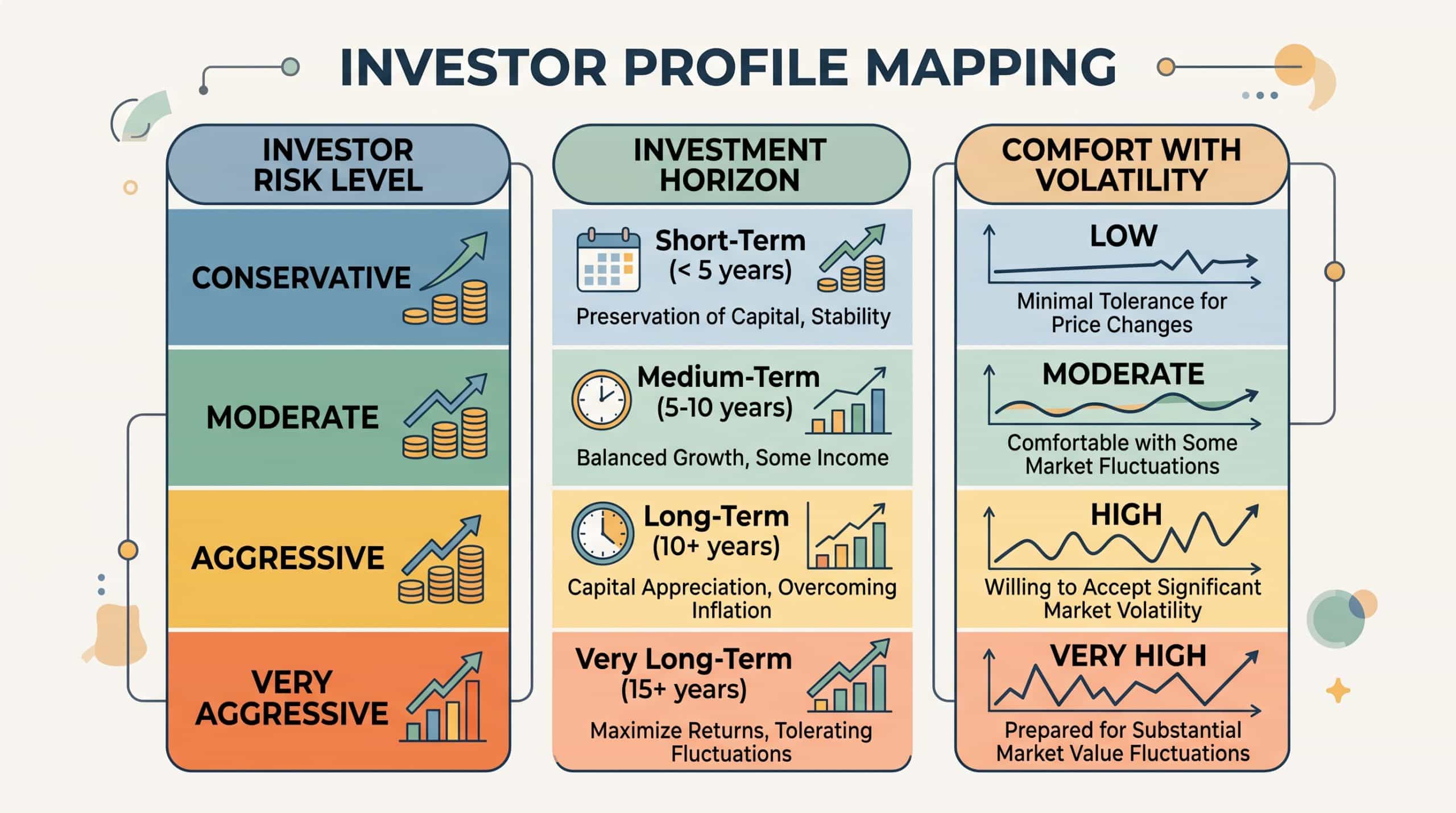
Ask yourself concrete questions. Could you stomach a 10% drop in your portfolio’s value over a short period? What about a 20% decline? Your honest answers, combined with your investment horizon, point toward a suitable risk level:
| Risk Level | Investment Horizon | Comfort with Market Volatility |
|---|---|---|
| Conservative | Short-term (less than 5 years) | Low |
| Moderate | Medium-term (5-10 years) | Moderate |
| Aggressive | Long-term (more than 10 years) | High |
| Very Aggressive | Long-term (more than 10 years) | Very High |
Reflecting on whether you want to pursue higher returns or prioritize preserving capital will help you make investment decisions that align with your goals and values.
Role of Technology in Investing
Technology harnesses vast amounts of data and sophisticated algorithms to support modern investing. Artificial intelligence and machine learning can analyze market data continuously, helping identify trends and patterns and supporting data-driven decisions that are less exposed to emotional bias. Technology-driven platforms also offer practical tools such as asset allocation models, portfolio rebalancing, and tax optimization strategies, while mobile apps and digital advisory services let you invest, manage, and track your portfolio anywhere, anytime.
The scale of technology-enabled, personalized investing keeps growing. JPMorgan Asset Management reports that in 2024, model portfolios totaled $37.8 billion of net inflows, a 62% increase from 2023 — evidence that digital, model-based approaches to personalization are gaining real traction.
Creating a Customized Portfolio
With your goals and risk tolerance defined, you can craft a portfolio that fits your situation. That means examining asset classes — such as stocks, bonds, and real estate — and determining the right mix for you, alongside your investment horizon and liquidity needs. If you’re close to retirement, for example, you may want to allocate a larger portion of your portfolio to more conservative investments. If you’re risk-averse, a balanced blend of low-risk and higher-risk holdings may suit you; if you’re comfortable with more risk, a higher allocation to stocks or alternative investments may be appropriate. The goal is a thoughtful, informed allocation tailored to your objectives rather than an off-the-shelf template.
Monitoring and Adjusting Investments
Once your portfolio is in place, regular monitoring keeps it aligned with your goals and risk tolerance. The SEC likewise suggests that investors consider rebalancing their portfolio occasionally so allocations don’t drift away from plan. A simple review cadence might look like this:
| Investment Type | Monitoring Frequency | Adjustment Criteria |
|---|---|---|
| Stocks | Quarterly | Changes in market trends or company performance |
| Bonds | Semi-annually | Changes in interest rates or credit ratings |
| Mutual Funds | Annually | Changes in fund management or performance vs. benchmarks |
Achieving Long-Term Financial Success
Long-term financial success rests on goal-oriented planning, discipline, and adaptability. Set clear objectives — retirement savings, a down payment on a house — and develop a tailored plan that reflects your risk tolerance, time horizon, and current finances. Stay disciplined: avoid impulsive moves driven by short-term market swings or news headlines, and resist the temptation to time the market. Stay adaptable: as your goals and circumstances change, review your portfolio and rebalance as needed so your strategy evolves with you.
Personalization matters in retirement planning, too. A Goldman Sachs Asset Management survey, as reported by Planadviser, found that competing financial priorities can erode defined contribution retirement savings, and pointed to tools such as financial wellness programs, digital investment advice, and managed accounts as potential solutions.
Frequently Asked Questions
How Do Personalized Investment Services Protect My Private Financial Information?
Services handling your money typically employ encryption, two-factor authentication, and strict confidentiality policies to safeguard your private information.
Are Personalized Investment Portfolios Only for High-Net-Worth Individuals?
No. Bespoke portfolios don’t necessarily require substantial wealth; many institutions now offer tailored strategies for investors of all stripes and wallet sizes.
What Are the Typical Fees Associated With Personalized Investment Services?
You’ll typically pay management fees ranging from 0.25% to 1.5% of your portfolio’s value annually, plus potential trading and administrative fees, depending on the services you choose.
Can I Adjust My Personalized Investment Portfolio at Any Time?
Most personalized services let you adjust your portfolio whenever you’d like and keep you updated in real time, giving you ongoing control over your investments.
How Do I Know if My Personalized Investment Advisor Is Qualified?
Check their credentials, such as professional certifications, experience, and education. You can also ask about their investment approach, risk management strategies, and how they’ll communicate with you about your portfolio.